
Time isn’t the same everywhere. That’s not a metaphor. According to general relativity, gravity actually slows the passage of time, and near a black hole, where gravity gets more extreme than anywhere else in the universe, that slowing becomes dramatic enough to matter. A clock sitting close to a black hole ticks measurably slower than one sitting far away, and it’s not an illusion caused by distance or light delay. Time itself, for that clock, genuinely passes at a different rate.
The Basic Idea
Einstein’s general relativity describes gravity as the warping of spacetime by mass, and the more mass packed into a given space, the more severe the warp. A black hole represents the most extreme case possible, mass compressed so densely that nothing, not even light, can escape once it crosses a boundary called the event horizon. Because spacetime itself is what clocks measure their ticking against, a clock deep in that warp experiences fewer ticks per second, relative to a distant observer’s clock, the deeper into the gravity well it sits. Viewed from far away, a clock approaching the event horizon appears to slow down and, in the limit, appears to freeze entirely, its ticks stretched toward infinity, though the clock itself, from its own perspective, notices nothing unusual as it crosses.
This Already Runs Your Phone’s GPS
This isn’t an exotic effect confined to black holes. Earth’s own gravity, far weaker, still causes a measurable version of it, and modern life quietly depends on correcting for it. GPS satellites orbit at high altitude, where Earth’s gravity is weaker, which speeds their onboard clocks up by about 45 microseconds a day relative to clocks on the ground. At the same time, their orbital speed slows those same clocks down by about 7 microseconds a day, a separate effect from special relativity. The net result is that satellite clocks run about 38 microseconds a day faster than ground clocks, and GPS systems are engineered to correct for that exact figure. Skip the correction and positioning errors would pile up by around 10 kilometers a day, fast enough to make GPS useless within hours.
This isn’t a rounding error physicists tolerate. It was tested directly in 1976, when NASA’s Gravity Probe A mission sent an atomic clock to about 10,000 kilometers altitude and measured its ticking rate against Einstein’s prediction. The match was precise.
What This Looks Like Near an Actual Black Hole
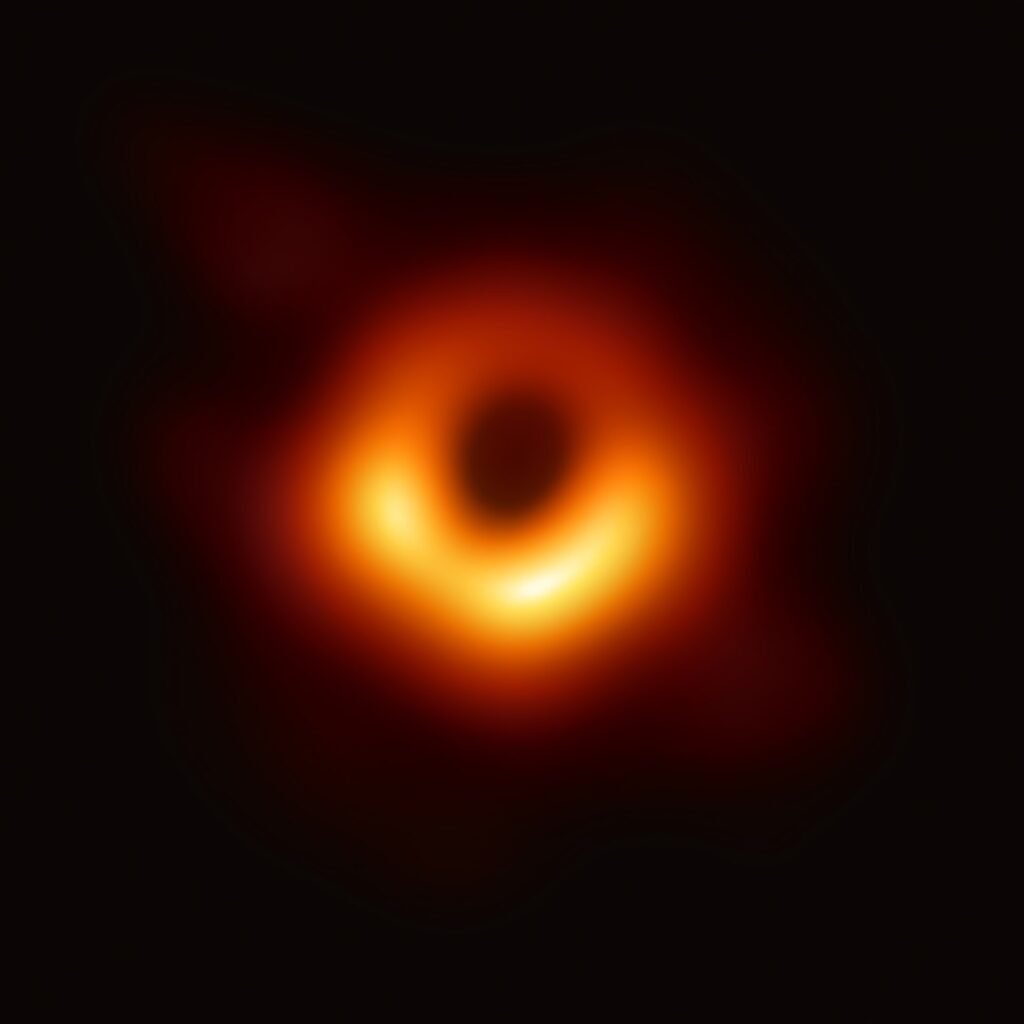
Near a real black hole, the effect gets far more severe than anything Earth’s gravity produces. The 2019 Event Horizon Telescope image of the supermassive black hole at the center of the galaxy M87 gave the public its first direct look at a black hole’s shadow, the boundary where light itself gets trapped, indirectly confirming the same relativistic framework that predicts extreme time dilation right at that edge.
The film Interstellar built an entire plot point around this physics, and it wasn’t taking creative liberties. Physicist Kip Thorne worked directly with the filmmakers to model “Miller’s planet,” a world orbiting close to a massive, fast-spinning black hole, where one hour on the planet’s surface corresponds to about seven years passing for anyone waiting farther away. Thorne’s calculations showed that ratio is physically achievable under general relativity, given a black hole massive and fast-spinning enough, which is a genuinely strange thing to be able to say about a Hollywood science fiction premise.
Sources and Credit
- NASA Science, “What Happens When Something Gets Too Close to a Black Hole?” science.nasa.gov
- Ohio State University Astronomy, “Real-World Relativity: The GPS Navigation System.” astronomy.ohio-state.edu
- Ashby, N. “Relativity in the Global Positioning System.” PMC/NIH. pmc.ncbi.nlm.nih.gov
- “Science inspired Interstellar, and film now returns the favor,” on Kip Thorne’s work modeling the film’s black hole. Science/AAAS. science.org
SAYKAYZ is a publishing platform, not a publisher of record. Any dispute over authorship or attribution is between the parties involved; please see our Terms of Service.