
Why Is the Night Sky Dark? The Paradox That Took 400 Years to Solve
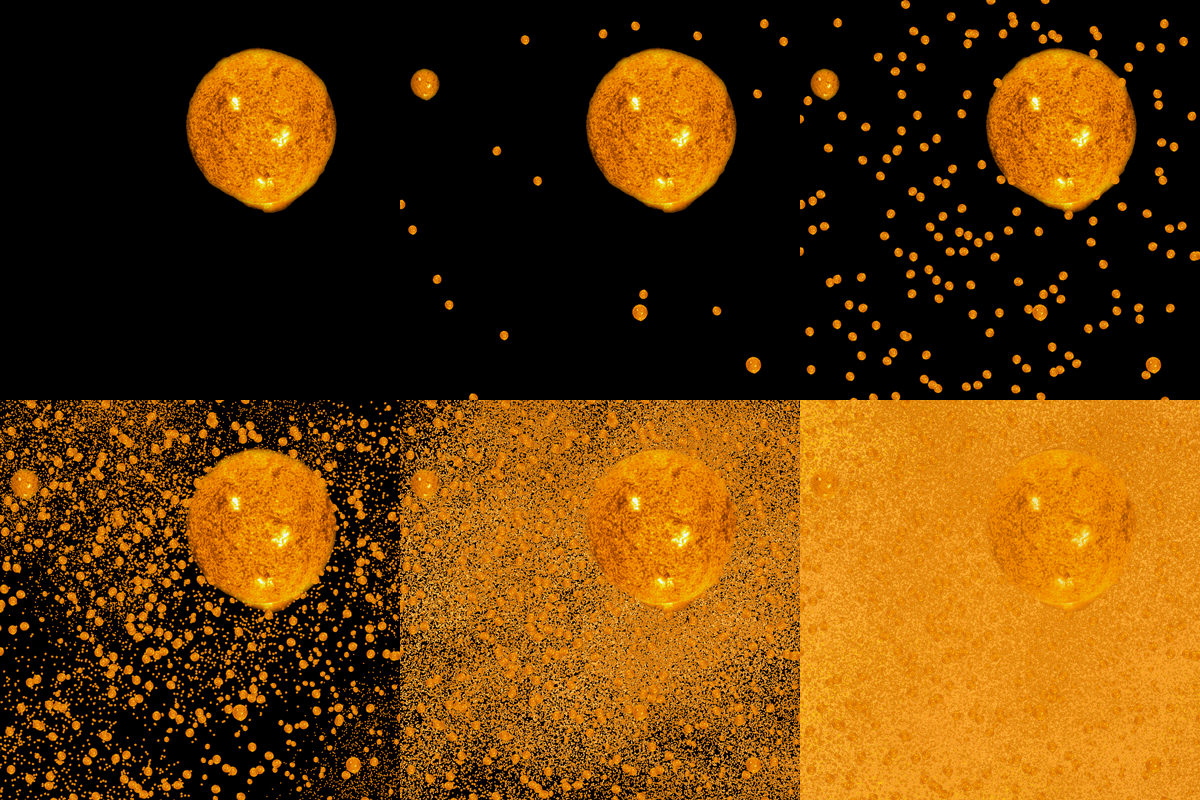
Look up on a clear, moonless night and you see mostly black, punctured by a scattering of points of light. It feels like the most obvious thing in the world, of course the sky is dark, the sun is on the other side of the planet. But that intuition falls apart the moment you take seriously what astronomers came to believe about the universe: that it’s full of stars, in every direction, as far as anyone can tell. If that’s true, simple geometry says the whole sky should be blazing. The fact that it isn’t turned out to be one of the more revealing puzzles in the history of astronomy.
The Argument That Shouldn’t Work
Picture the universe as an endless field of stars scattered roughly evenly in every direction, which is close to what astronomers before the 20th century generally assumed. Now pick any direction to look. If space keeps going forever and stars keep appearing at every distance, your line of sight has to hit a star’s surface eventually, no matter which way you point. A star that’s farther away looks dimmer, but there are also more stars at greater distances to make up for it, since the volume of space at any given distance keeps growing. Work through the math and the two effects cancel out almost exactly. The conclusion is that an infinite, unchanging, evenly star-filled universe should have a night sky as bright, everywhere, as the surface of an average star. Instead we get darkness with pinpricks of light in it. Something in the setup has to be wrong.
Older Than You’d Think
This puzzle usually gets attributed to Heinrich Olbers, a German astronomer who wrote about it in 1823, and it carries his name for that reason. But he wasn’t close to the first person to notice the problem. Johannes Kepler raised a version of it as early as 1610, and other astronomers, including Edmond Halley and Jean-Philippe de Chéseaux, wrestled with it across the following two centuries. Each proposed partial explanations, mostly involving dust or gas absorbing distant starlight, which sounds reasonable until you realize that absorbing material would eventually heat up and start glowing itself, which just relocates the problem rather than solving it.
An Unlikely Source for the Right Answer
One of the clearer early statements of the actual solution came from an unexpected author: Edgar Allan Poe. In 1848, in a long prose essay called Eureka, better known as speculative philosophy than science, Poe argued that the only way to explain the darkness was if the universe hadn’t existed forever, that there had to be a point in the past before any stars had started shining, meaning their light simply hadn’t had time to reach Earth yet. He got there through reasoning rather than observation or mathematics, and he wasn’t taken very seriously as a scientific thinker in his own time, but the core insight anticipated where cosmology would actually land more than half a century before the tools existed to confirm it.
What Actually Resolves It
The modern answer rests on two things astronomers didn’t fully appreciate until the 20th century. First, the universe has a finite age, roughly 13.8 billion years since the Big Bang, and stars and galaxies only started forming a few hundred million years into that timeline. Light travels fast, but it isn’t instantaneous, so we can only receive light from objects close enough that their light has had time to complete the journey. Most of the universe, if it does extend farther than what’s observable, is simply too far away for its light to have arrived yet. Second, the universe is expanding, which stretches the wavelength of light from very distant, very old sources into the infrared and beyond, well outside what human eyes register as visible light. Between the two effects, finite age limiting what light has reached us, and expansion dimming and redshifting much of what has, the night sky ends up mostly dark, with a sprinkling of visible stars close enough and young enough for their light to actually reach us at wavelengths we can see.
Darkness as Evidence
What makes this more than a historical curiosity is what the dark sky is actually telling you. It isn’t a gap in your view of an unchanging cosmos, it’s direct visual evidence that the universe had a beginning and has been changing ever since. Every dark patch between the stars is, in a real sense, showing you the edge of what light has had time to reach. The night sky isn’t empty. It’s a limit, drawn by time itself, and it took nearly two and a half centuries of accumulated observation, false starts, and one strange assist from a horror writer to figure out what that limit meant.
Sources & Credit
- “Olbers’ paradox,” overview article, Wikipedia, cross-checked against Penn State’s Astro 801 course materials. en.wikipedia.org
- “Olbers’ Paradox,” ASTRO 801: Planets, Stars, Galaxies, and the Universe, Penn State University. courses.ems.psu.edu
- “Edgar Allan Poe: visionary of big bang cosmology?” Aeon. aeon.co
- “Edgar Allan Poe’s Eureka and the Big Bang,” Starts With A Bang, Paul Halpern. medium.com
- Featured image: illustration of Olbers’ paradox, by Kmarinas86, via Wikimedia Commons, licensed CC BY-SA 3.0. commons.wikimedia.org
SAYKAYZ is a publishing platform, not a publisher of record. Any dispute over authorship or attribution is between the parties involved; please see our Terms of Service.