
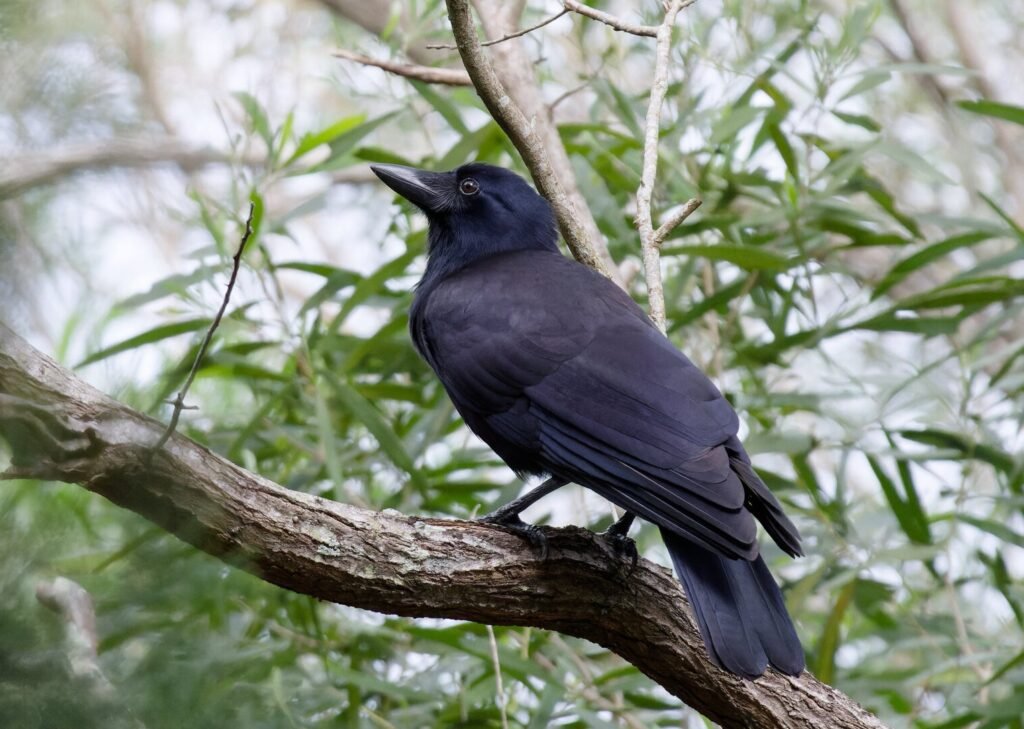
In 2005, a New Caledonian crow named Betty was handed a straight piece of wire and a small bucket of food sitting out of reach at the bottom of a tube. Nobody had trained her to do anything with wire. Betty bent it into a hook, using her beak to make several precise bends, then used the hook to lift the bucket out. Researchers had planned to compare her performance with a straight versus a hooked tool. She solved that comparison herself by manufacturing the tool she needed. It wasn’t a fluke either. Betty went on to make hooks repeatedly, and the discovery reframed how seriously scientists take corvid cognition.
Tools That Look Deliberate, Not Accidental
Betty belongs to a species, the New Caledonian crow, that had already been documented making tools in the wild before her lab appearance made headlines. Researcher Gavin Hunt spent years studying wild populations on the South Pacific island of New Caledonia and found they manufacture at least two distinct kinds of hook tools: ones bent from twigs, and ones cut and shaped from the barbed edges of pandanus leaves into tapered, stepped designs. What stood out to Hunt wasn’t just that the crows used tools, plenty of animals do that, it was the standardization. Individual crows across a population made tools to a consistent, repeatable pattern, with real shaping and imposition of form rather than just picking up whatever stick happened to work. That level of manufactured consistency in a wild, non-human animal had previously only been associated with early human toolmaking traditions. Follow-up genetic and morphological research even found that New Caledonian crows have an unusually straight bill compared to other crow species, a shape that appears to have evolved specifically to make handling and wielding these tools easier, suggesting tool use has been shaping the species’ anatomy over evolutionary time, not just its behavior.
A Grudge That Lasted Seventeen Years
A different, longer-running study out of the University of Washington shows just how far crow memory extends, and it centers on human faces rather than tools. In 2006, biologist John Marzluff and his students trapped and banded seven wild crows on campus while wearing a rubber caveman mask, a deliberately unfamiliar and vaguely threatening face. A second mask, a likeness of Dick Cheney, was worn during neutral, non-threatening walks as a control. Almost immediately, the trapped crows began scolding and mobbing anyone who wore the caveman mask, loud alarm calls, group harassment, the full response reserved for a known threat. That alone wasn’t surprising. What was surprising is what happened next. Crows that had never been trapped, including some born years after the original incident, learned to scold the same mask too, apparently by watching and picking up the behavior from other crows in the flock. The proportion of crows reacting to the mask kept climbing for years, and Marzluff found that roughly four in every ten crows encountered on campus were still scolding it more than a decade later. He finally walked the mask through campus again in September 2023, about seventeen and a half years after the original trapping. That time, nothing. No scolding.
Why a Bird Can Do This Without a Neocortex
For a long time, the assumption in comparative neuroscience was that real problem-solving intelligence required a neocortex, the layered outer structure found in mammalian brains, and birds simply don’t have one. Their forebrains are built around a different structure called the pallium, organized in dense clusters rather than the neocortex’s neat layers. What research on corvids and parrots has shown is that this different architecture can still pack in an enormous number of neurons relative to brain size, in some cases at densities that rival primates. The wiring looks nothing like a mammalian brain, but functionally it seems to support planning, tool manufacture, social learning, and long-term memory anyway. It’s a case of convergent evolution: two very different lineages, birds and mammals, separately arriving at brains capable of similar cognitive feats through completely different internal blueprints.
That’s the part worth sitting with. A crow watching another crow get trapped, learning to associate a specific human face with danger, and passing that warning down through a population for close to two decades isn’t running on borrowed mammalian hardware. It built that capacity from scratch, on its own evolutionary path, with a brain that doesn’t look anything like ours doing something we’d call, without hesitation, remembering.
Sources & Credit
- Hunt, G.R. “Manufacture and use of hook-tools by New Caledonian crows.” Nature 379, 249-251 (1996). nature.com
- “Unique beak evolved with tool use in New Caledonian crow,” Cornell Chronicle. news.cornell.edu
- “UW professor learns crows don’t forget a face,” The Seattle Times. seattletimes.com
- “Is That a Caveman or Dick Cheney? Crows Know the Difference,” Science/AAAS. science.org
- Featured image: New Caledonian crow (Corvus moneduloides), by Donald Davesne, via Wikimedia Commons, licensed CC BY 4.0. commons.wikimedia.org
SAYKAYZ is a publishing platform, not a publisher of record. Any dispute over authorship or attribution is between the parties involved; please see our Terms of Service.