
The Octopus Has Nine Brains and Most of the Thinking Isn’t in Its Head
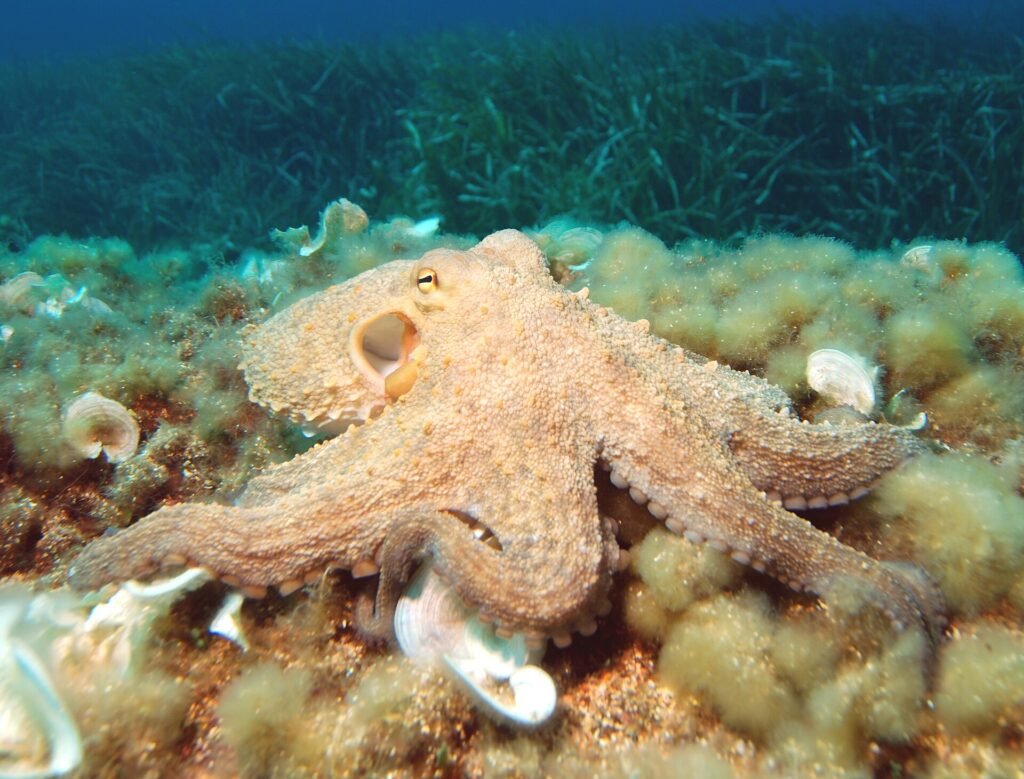
An octopus has about 500 million neurons, roughly on par with a dog. What makes an octopus strange isn’t the total number, it’s where they live. Only about a third of those neurons sit in the central brain between its eyes. The other two-thirds are distributed through its arms, and each arm has enough local processing power to act with a real degree of independence from the brain that supposedly runs the show.
Nine Brains Is a Simplification, but Not a Wild One
The central brain contains roughly 180 million neurons. Each of the eight arms has its own cluster of around 40 million neurons, organized into a long nerve cord with ganglia, small local processing nodes, spaced along its length. Calling this “nine brains” oversells it. It’s one nervous system with unusually powerful regional outposts rather than nine separate minds having eight separate opinions. But the arms genuinely do process touch, taste, and movement locally, without waiting for instructions from the center.
A study from the Okinawa Institute of Science and Technology, published in Current Biology, made this concrete. Researchers electrically stimulated a severed octopus arm and watched it move in the same coordinated patterns a normal, attached arm would use, adjusting those patterns when its position changed. The arm wasn’t just twitching. It was still computing.
Learning in the Brain, Executing in the Arms
More recent research complicates the “arms think for themselves” story in an interesting way. It now looks like learning mostly happens in the central brain, and that learned information becomes available to the arms afterward, rather than each arm independently figuring things out and never telling the brain. The relationship looks less like eight semi-autonomous limbs and more like a brain that delegates execution to highly capable local hardware once it’s decided what needs doing.
Skin That Might Be an Eye
Octopus camouflage runs on three layered structures in the skin. Chromatophores are pigment-filled sacs surrounded by tiny muscles; when those muscles contract, the sac stretches flat and its color, usually red, yellow, orange, or brown, becomes visible, and because the whole system is under direct neural control it can change color within milliseconds. Beneath the chromatophores sit iridophores, reflective plates that produce iridescent blues, greens, and silvers, and beneath those, leucophores scatter light to create white for contrast. Together the three layers let an octopus match backgrounds far more complex than a simple color-matching trick should allow.
One detail makes this stranger. Chromatophores contain the same light-sensitive proteins found in an eye’s retina. That’s led some researchers to a genuinely open question: does an octopus’s skin sense light directly, independent of its actual eyes, and use that information to help tune its own camouflage in real time? Nobody has fully settled it, but the biochemistry is there to make the case plausible.
What the Jar-Opening Says About All of This
Captive octopuses have been repeatedly observed unscrewing jar lids to reach food inside, and opening tank latches that were never meant to be opened from the inside. In lab settings, an octopus that watches another octopus solve that exact puzzle tends to solve it faster afterward itself. None of that requires nine independent minds. It requires one genuinely capable brain, backed by a body that can carry out fine, adaptive movement without constant supervision, which might be an even stranger arrangement than the popular version of the story.
Sources and Credit
- Okinawa Institute of Science and Technology, “Do octopuses’ arms have a mind of their own?” oist.jp
- ScienceDaily coverage of the OIST/Current Biology study. sciencedaily.com
- “Cephalopod Camouflage: Cells and Organs of the Skin,” Nature Scitable. nature.com
SAYKAYZ is a publishing platform, not a publisher of record. Any dispute over authorship or attribution is between the parties involved; please see our Terms of Service.