
The Moon Is Drifting Away From Earth, and We Can Measure It to the Millimetre
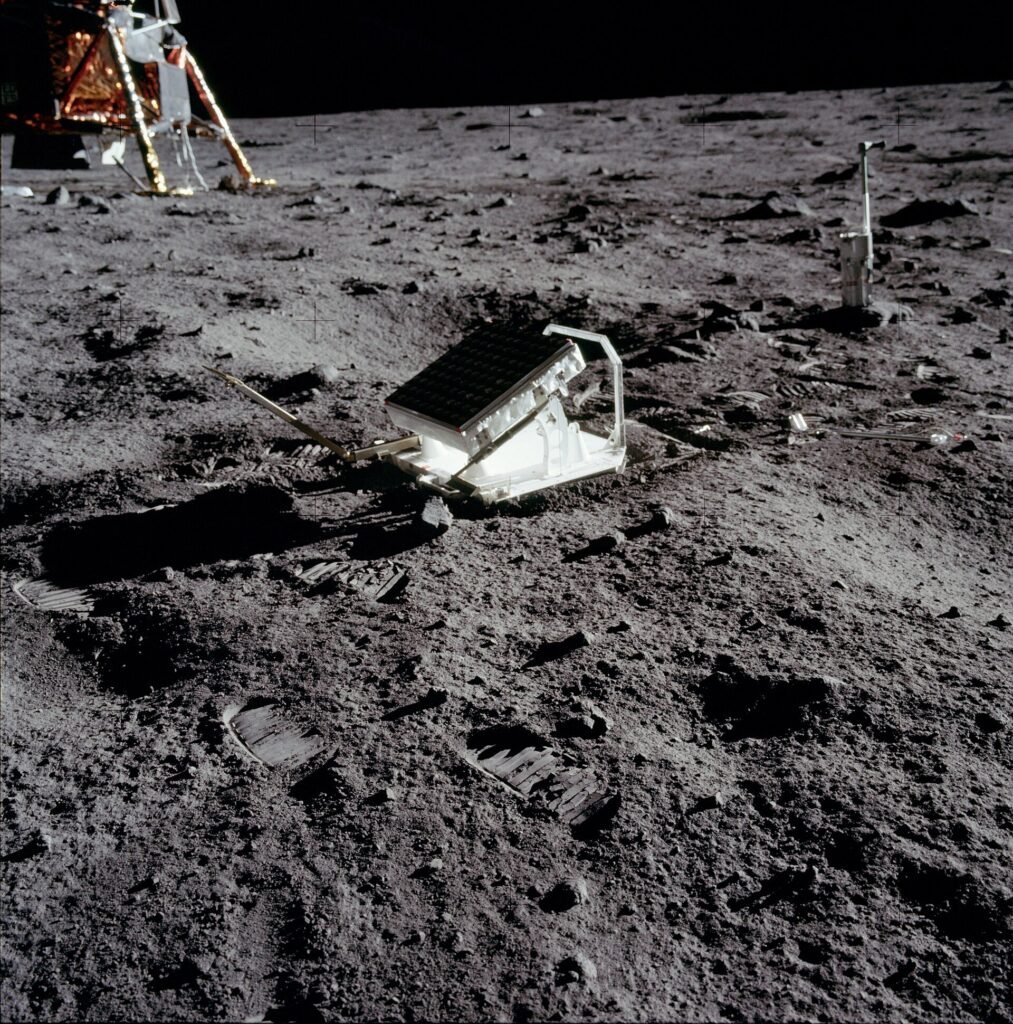
The Moon is leaving. Slowly, by about 3.8 centimetres a year, roughly the speed your fingernails grow. That number is not an estimate pulled from a model. It is measured, night after night, by firing lasers at mirrors that astronauts left on the lunar surface more than fifty years ago.
Mirrors Left Behind by Apollo
When Apollo 11 landed in July 1969, Neil Armstrong and Buzz Aldrin set up a flat panel of glass prisms a short walk from their lander. The crews of Apollo 14 and 15 left two more. The Apollo 11 and 14 arrays each hold 100 prisms called corner cubes, and the Apollo 15 array holds 300. A corner cube has a useful property: light that enters it bounces back in exactly the direction it came from. Two Soviet Lunokhod rovers carried similar reflectors.
From observatories on Earth, scientists fire short, powerful laser pulses at these arrays and time how long the light takes to return, about two and a half seconds for the round trip. Most of the light is lost along the way, and only a tiny fraction of the photons make it back to the telescope. But that is enough. Because the speed of light is known so precisely, the timing gives the distance between Earth and Moon to within a few millimetres.
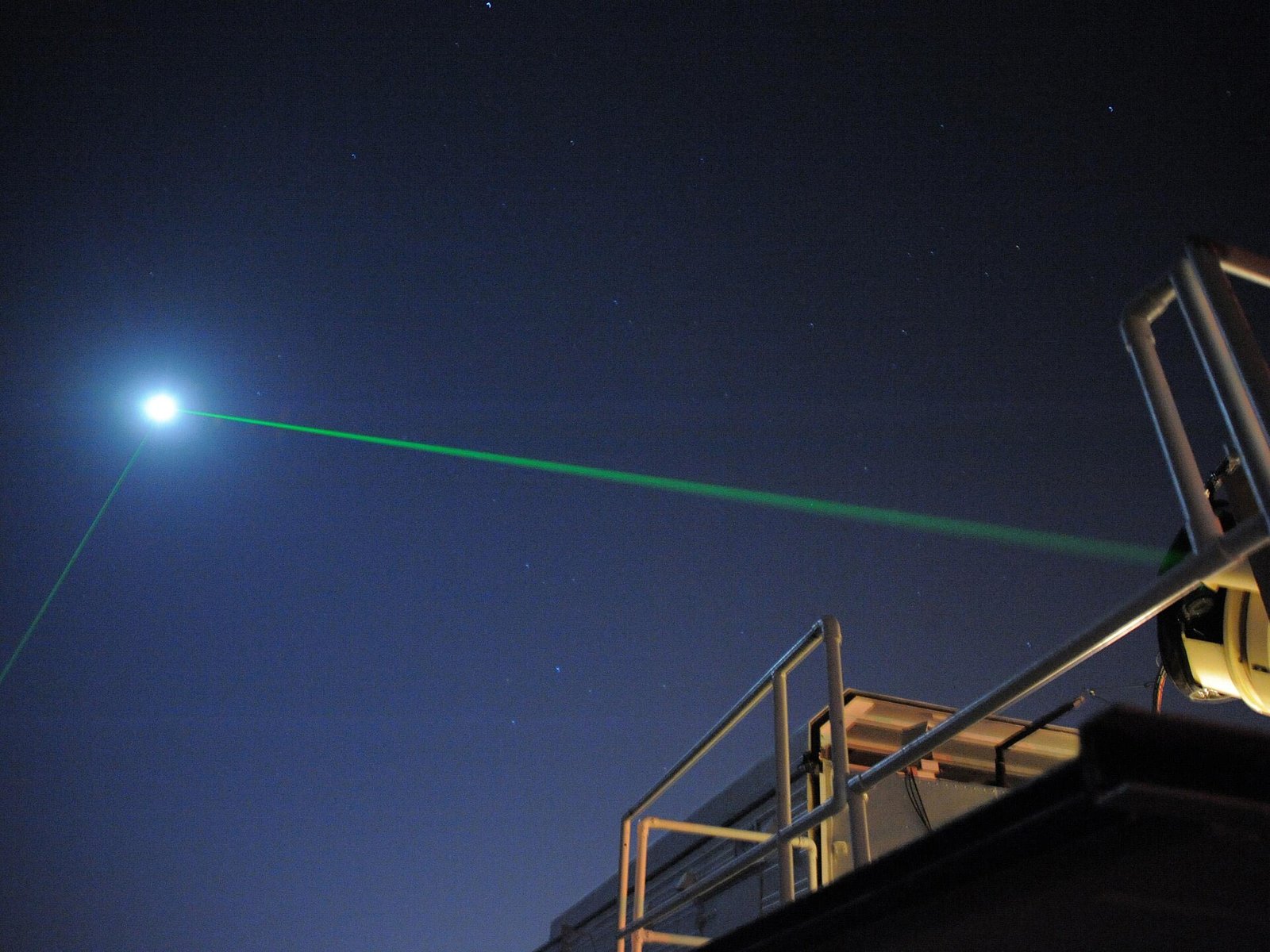
Decades of these measurements have shown the steady outward drift, along with other surprises. The data revealed that the Moon has a fluid core, and it has been used to test Einstein's theory of gravity with great precision.
Why the Moon Is Moving Away
The cause is the tides. The Moon's gravity pulls on Earth's oceans and raises a bulge of water on the side facing it, and another on the far side. Earth spins much faster than the Moon orbits, once a day compared with once in about 27 days, so the planet's rotation drags those bulges slightly ahead of the line between Earth and Moon.
That offset bulge has its own gravity, and it tugs the Moon forward along its orbit, giving it a little extra energy. A Moon with more orbital energy moves out to a wider orbit. In return, the bulge pulls back on Earth through friction between the moving water and the seabed, gradually slowing the planet's spin. Our days are getting longer, by a few thousandths of a second every century. It is one slow exchange: Earth loses spin, and the Moon gains distance.
Corals That Counted Shorter Days
If days are getting longer, they must have been shorter in the past, and there is physical evidence of it. In 1963, the American paleontologist John Wells studied fossil corals from the Devonian period, about 400 million years ago. Corals lay down fine daily growth lines, and thicker bands each year as the seasons change. Counting the daily lines inside one yearly band, Wells found around 400 of them. A year back then had about 400 days.
The year itself was about the same length. Earth's orbit around the Sun has not changed much. What changed was the day. If a year held 400 days, each day was only about 22 hours long.
Going further back is harder, but in 2018 geologists Stephen Meyers and Alberto Malinverno used patterns recorded in 1.4-billion-year-old rock from northern China, linked to wobbles in Earth's orbit and spin, to work out the length of the day at that time. Their answer was just over 18 hours, with the Moon correspondingly closer.
Will the Moon Escape?
Not any time soon. Scientists think today's rate is faster than the long-term average, because of the way the present-day ocean basins respond to the tides. Over billions of years the drift should slow. Long before the Moon could leave, the Sun will have changed so much that the question becomes irrelevant.
Still, it is a strange thought that the Moon in your sky is a few metres further away than the one your grandparents saw. And it is stranger still that we know this because of a few panels of glass, set down on the dust in 1969 and still answering every time someone shines a light at them.
Sources and Credit
- "The Apollo Experiment That Keeps on Giving," NASA Jet Propulsion Laboratory. jpl.nasa.gov
- "John W. Wells & Coral Geochronometry," Paleontological Research Institution. priweb.org
- "Thank the moon for Earth's lengthening day," ScienceDaily, on Meyers and Malinverno in PNAS (2018). sciencedaily.com
- Featured image: The Apollo 11 laser ranging reflector panel on the lunar surface, by NASA, via Wikimedia Commons, in the public domain. commons.wikimedia.org
- Image: A green laser beam fired toward the Moon from NASA's Goddard laser ranging facility, by NASA, via Wikimedia Commons, in the public domain. commons.wikimedia.org
SAYKAYZ is a publishing platform, not a publisher of record. Any dispute over authorship or attribution is between the parties involved; please see our Terms of Service.