
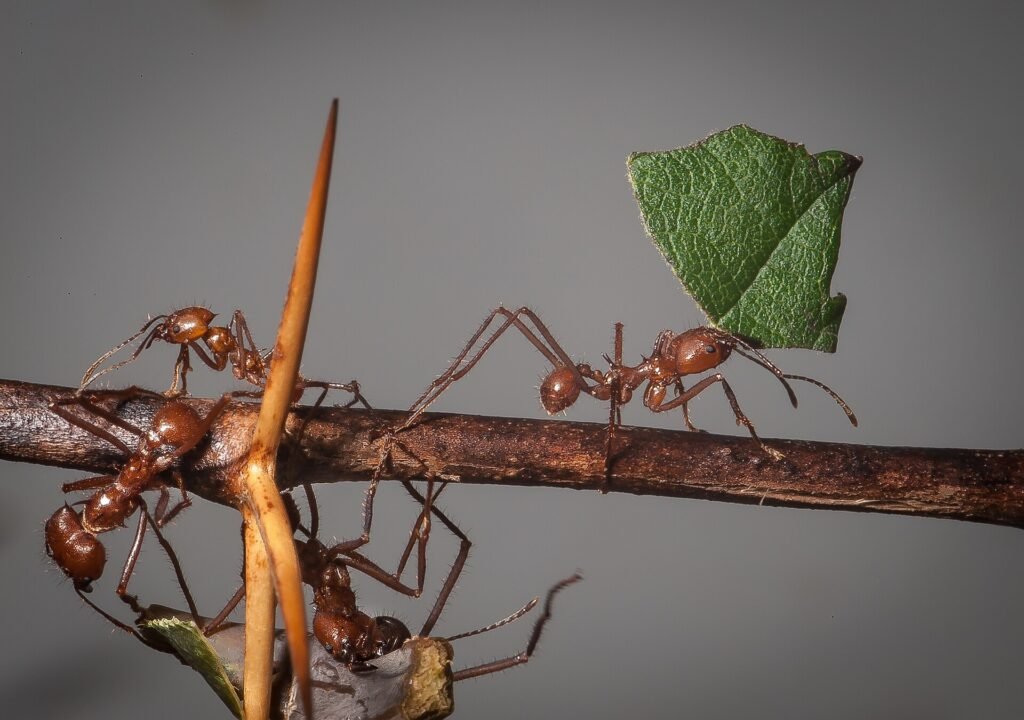
Walk through a forest in Central or South America and you may see a moving green line on the ground: thousands of ants, each carrying a piece of leaf bigger than itself. It looks as if they are carrying food home. They are, in a way, but the ants do not eat the leaves. They feed them to a fungus, and they eat the fungus. Leafcutter ants are farmers, and they have been at it far longer than we have.
A Farm Underground
A large leafcutter colony can hold millions of workers living in a nest that extends metres underground, with hundreds of chambers. Many of those chambers hold fungus gardens, spongy masses of fungus growing on a bed of chewed-up leaf. The colony runs like a farming operation with a strict division of labour, and workers come in very different sizes to do different jobs:
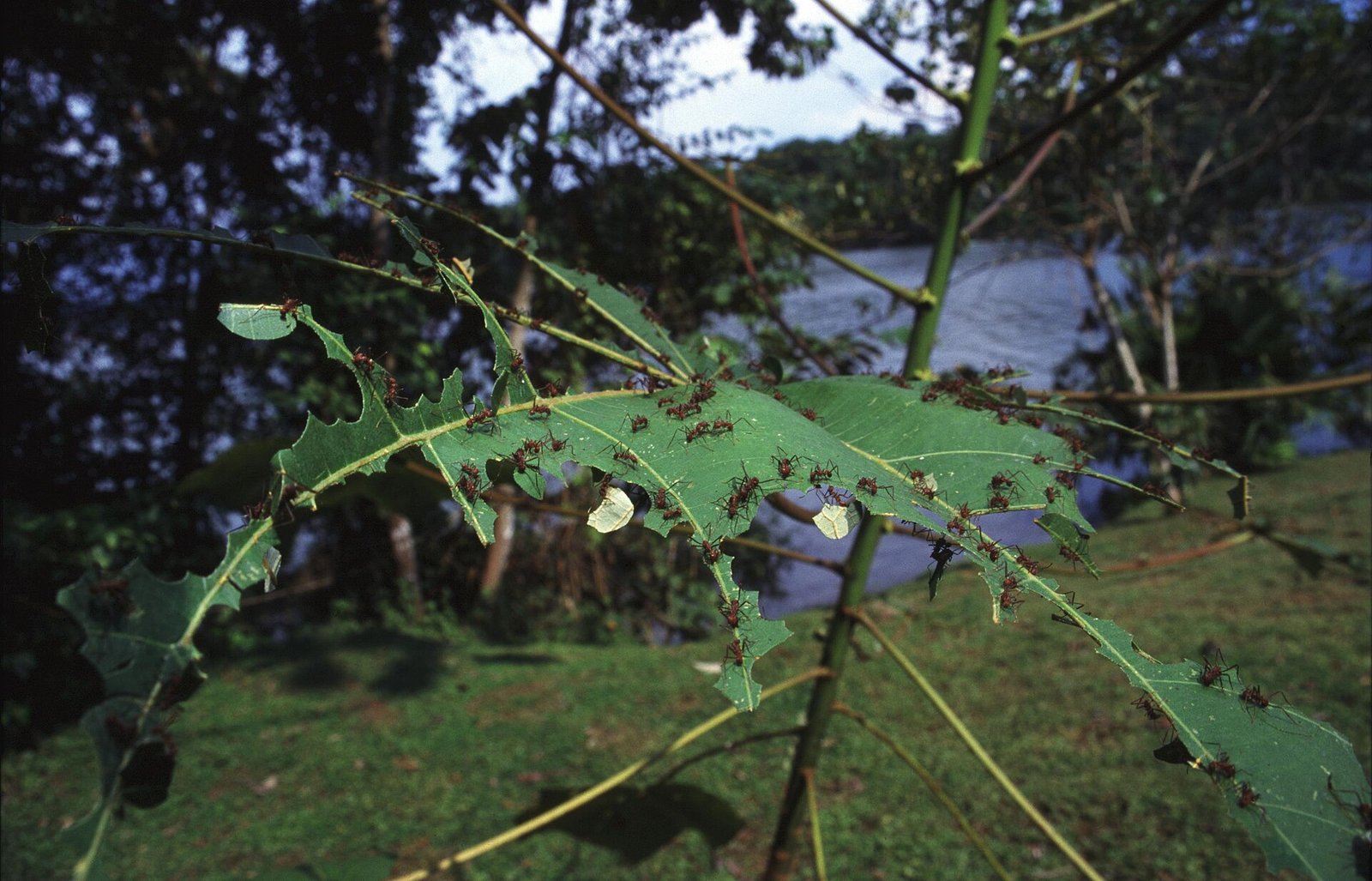
- Large workers cut leaves and carry them back along cleared trails.
- Smaller workers inside the nest chew the leaves into pulp and plant tufts of fungus on it.
- The smallest workers tend the gardens, cleaning them and weeding out anything that should not be there.
- Big-headed soldiers guard the nest and the foraging trails.
The fungus the most advanced leafcutters grow, called Leucoagaricus gongylophorus, has been bred by the ants for so long that it no longer lives anywhere else. In return for the leaves, it produces small swollen tips packed with sugars and fats that the ants harvest and eat, and feed to their larvae. Neither partner can now survive without the other.
Fifty Million Years of Agriculture
Fungus farming among ants began long before leafcutters existed. Researchers studying the ant family tree estimate that the first fungus-farming ants appeared in South America somewhere between 50 and 65 million years ago, descended from ants that hunted and scavenged.
A study published in 2017 by Michael Branstetter, Ted Schultz and colleagues at the Smithsonian's National Museum of Natural History compared DNA from 119 living ant species to trace how farming developed. They found that a more advanced form of agriculture, in which the ants fully domesticated their fungus, appeared about 30 million years ago. That shift seems to have happened as the climate cooled and dried and the ants spread into drier habitats. In a dry environment, the fungus could not survive outside the humid nest, so it could not escape and breed with wild relatives. It became fully dependent on its farmers, much as our crops depend on us.
Leafcutters themselves are a later chapter in that story, and they took the idea of farming to its largest scale.
Pest Control With Antibiotics
Any farm attracts pests, and fungus gardens have a serious one: another fungus called Escovopsis, which attacks and can destroy a garden. In 1999, a team led by Cameron Currie published a study in Nature showing how the ants fight back. Many fungus-farming ants carry bacteria on their bodies, in a genus called Pseudonocardia, which produce antibiotic chemicals that suppress Escovopsis.
The bacteria live in particular places on the ants' outer skeleton, and they are passed from one generation to the next. A queen leaving to found a new colony carries both a piece of fungus from her mother's garden and these protective bacteria. The ants, in effect, were using antibiotics in their agriculture tens of millions of years before people discovered penicillin.
What Ants Got There First
It is easy to call ant farming a coincidence of evolution, and in one sense it is. Ants did not plan anything. But the parallels with human agriculture are hard to miss: domesticated crops that cannot live in the wild, specialised labour, pest management and the careful passing of seed stock to the next generation. Humans started farming around 12,000 years ago. Leafcutter ants were tending gardens in the dark for millions of years before that.
Sources and Credit
- "Ant Agricultural Revolution Began 30 Million Years Ago in Dry, Desert-like Climate," Smithsonian, on Branstetter et al. in Proceedings of the Royal Society B (2017). si.edu
- "Ant-Fungus Relationship May Provide New Clues About Antibiotics," ScienceDaily, on Currie et al. in Nature (1999). sciencedaily.com
- "Ants perfected farming 30 million years ago in the desert," Popular Science. popsci.com
- Featured image: Leafcutter ants on a twig, one carrying a cut piece of leaf, by Pjt56, via Wikimedia Commons, licensed CC BY-SA 4.0. commons.wikimedia.org
- Image: Leafcutter ant workers cutting a small plant, by Christian R. Linder, via Wikimedia Commons, licensed CC BY-SA 3.0. commons.wikimedia.org
SAYKAYZ is a publishing platform, not a publisher of record. Any dispute over authorship or attribution is between the parties involved; please see our Terms of Service.