
How Quantum Computers Use Superposition to Solve Problems Classical Computers Can’t
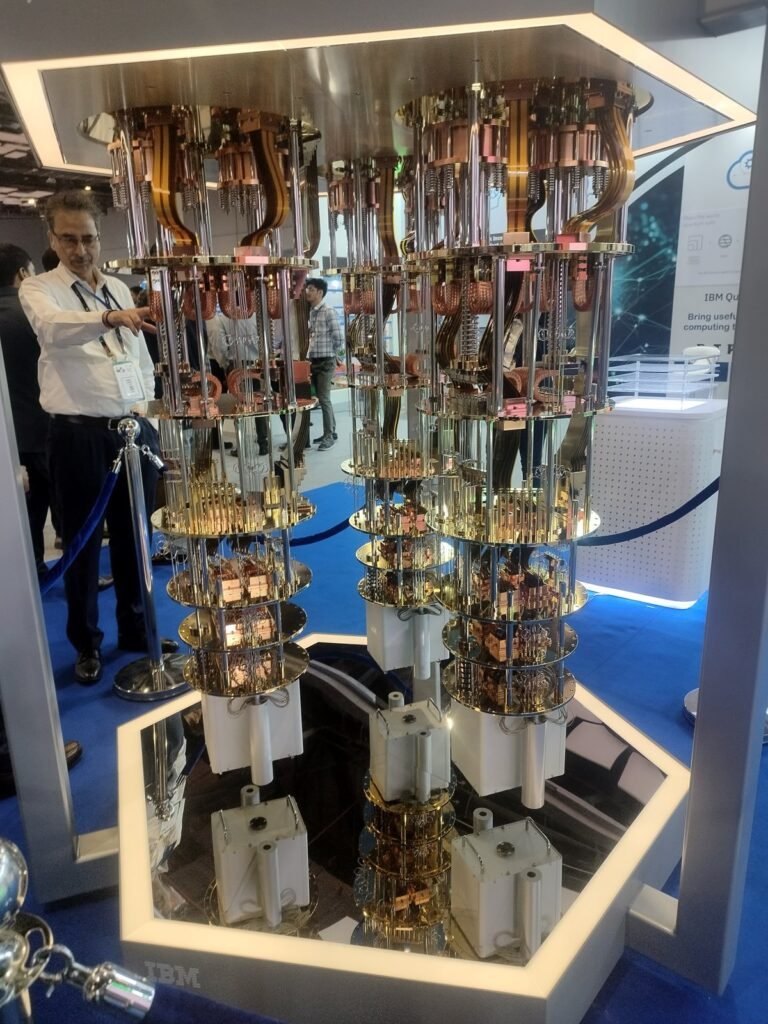
A classical computer bit is either a 0 or a 1, always, no ambiguity. A qubit, the basic unit of a quantum computer, can be described as some mixture of both at once, a state called superposition, right up until the moment you measure it. That sounds like a party trick more than an engineering advantage, and on its own, it kind of is. What actually makes quantum computers powerful isn’t superposition by itself, it’s what becomes possible when you combine it with two other quantum properties, entanglement and interference, in a way that has no equivalent in classical computing at all.
A Qubit Isn’t Just “Both at Once”
The common shorthand, that a qubit is 0 and 1 simultaneously, undersells what’s actually going on. A qubit’s state is better described as a combination of 0 and 1 weighted by two numbers called amplitudes, which determine the probability of getting each result when the qubit is finally measured. Stack multiple qubits together and the possibilities compound fast: a system of n qubits can represent a combination of 2 to the power of n different states simultaneously, growing exponentially with every additional qubit added. Twenty qubits can represent over a million combined states at once. A hundred qubits can represent more states than there are atoms on Earth. That exponential scaling is the raw resource quantum computers have available that classical bits simply don’t.
Entanglement Links Qubits Together
Superposition alone would still just be a really large table of probabilities. Entanglement is what makes qubits behave as a single correlated system rather than a pile of independent coin flips. When two qubits become entangled, the outcome of measuring one is directly correlated with the outcome of measuring the other, no matter how the system is structured, in a way that has no classical counterpart. Entangling many qubits together lets a quantum computer manipulate that entire exponentially large space of possible states as one connected structure, rather than as separate, disconnected possibilities.
The Part That Actually Does the Computing: Interference
Here’s the piece that trips people up most, because it’s the one that actually explains why quantum computers can solve certain problems faster, not just “hold more numbers.” A quantum algorithm doesn’t just check every possible answer inside its superposition and magically read off the right one, measuring a qubit destroys the superposition and just gives you one random result. Instead, quantum algorithms are carefully designed so that the amplitudes tied to wrong answers interfere destructively, canceling each other out, while the amplitudes tied to right answers interfere constructively, reinforcing each other, in the lead-up to a final measurement. Grover’s algorithm, built for searching an unsorted list, works this way, turning what would take roughly N steps on a classical computer into roughly the square root of N steps by repeatedly amplifying the correct answer’s amplitude. Shor’s algorithm, which can factor large numbers efficiently, uses the same interference principle in a different mathematical setting, which is also why it threatens the math underlying most of today’s encryption, since that encryption relies on factoring large numbers being practically impossible for classical computers.
Why Qubits Need to Be So Isolated
None of this works if a qubit’s delicate superposition gets disturbed before the computation finishes, and that’s the central engineering headache of the entire field. Any unwanted interaction with the surrounding environment, stray heat, vibration, electromagnetic noise, can collapse a qubit’s superposition prematurely, a process called decoherence, which effectively erases the quantum information mid-calculation and introduces errors. That’s the real reason quantum computers look the way they do in photos, chips cooled to temperatures colder than deep space, suspended in elaborate isolation chambers. Even with that isolation, errors creep in, which is why so much current quantum computing research is focused on error correction, spreading one reliable “logical” qubit across many physical qubits so the system can detect and fix mistakes faster than they accumulate. Google’s Willow chip, described in a December 2024 Nature paper, was a notable milestone here: as researchers scaled up the grid of physical qubits used to encode a single logical qubit, the error rate went down instead of up, a long-sought threshold that shows the error-correction approach can actually work as systems get bigger.
Powerful, Not Yet Practical
It’s worth being honest about where things actually stand. Willow completed a specific, deliberately quantum-favoring benchmark task in minutes that would take classical supercomputers an almost incomprehensible span of time, but that benchmark was chosen because it plays to quantum computing’s strengths, not because it solves a problem anyone needed solved. As of 2026, no quantum computer, from Google, IBM, or anyone else, is running large-scale, fully error-corrected algorithms on real-world problems yet, and most major labs are now pointing toward the end of the decade for that kind of general-purpose, fault-tolerant machine to arrive. The physics behind quantum computing works, and increasingly, so does the error correction that keeps it working at scale. What’s left is mostly the hard, unglamorous engineering of building it bigger without it falling apart, which tends to be exactly the part that takes the longest.
Sources & Credit
- “Meet Willow, our state-of-the-art quantum chip,” Google Research Blog. blog.google
- “Google Debuts New Quantum Chip, Error Correction Breakthrough, and Roadmap Details,” HPCwire. hpcwire.com
- “Willow processor,” background on the chip’s benchmark results. en.wikipedia.org
- “Intro to quantum computing: Qubits, superposition, & more,” Educative. educative.io
- Featured image: IBM quantum computer demo, by Dev Jadiya, via Wikimedia Commons, licensed CC BY-SA 4.0. commons.wikimedia.org
SAYKAYZ is a publishing platform, not a publisher of record. Any dispute over authorship or attribution is between the parties involved; please see our Terms of Service.