
How Noise-Cancelling Headphones Erase Sound by Making More of It
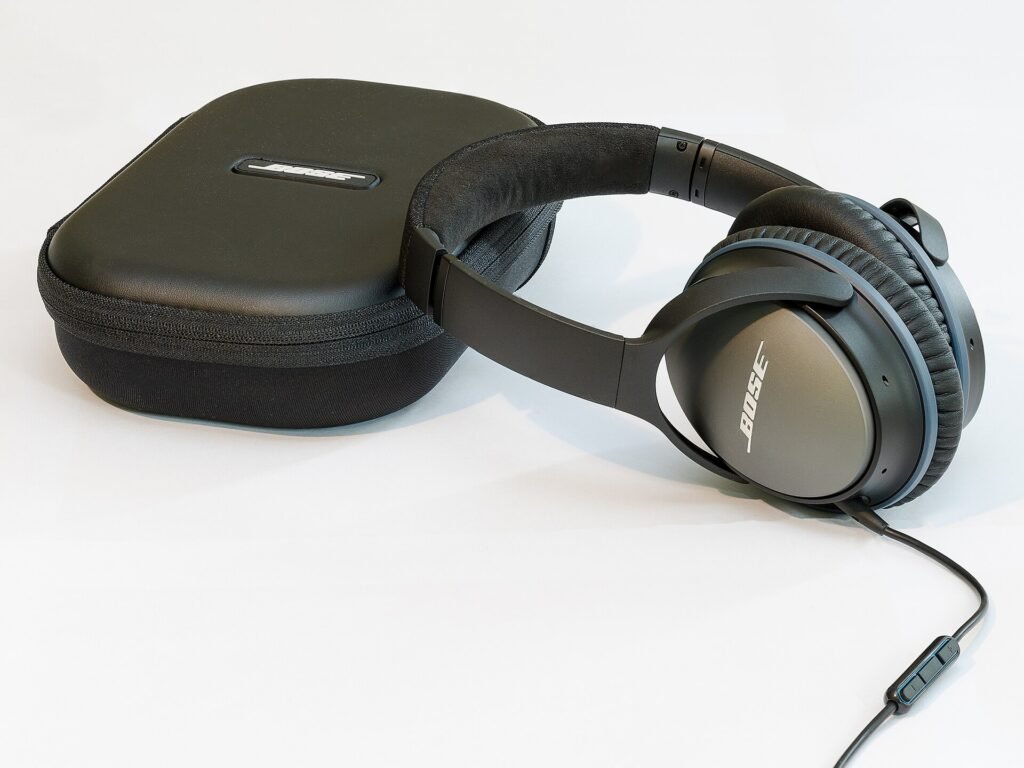
Put on a pair of noise-cancelling headphones on a plane and the roar of the engines drops away to a faint hiss. It feels as if the headphones are blocking the noise, like very good earplugs. Mostly they are doing the opposite. They are listening to the noise and playing extra sound into your ears, carefully shaped so that it cancels out what you would otherwise hear.
Sound Is a Wave, and Waves Can Cancel
Sound travels through air as a pressure wave: tiny regions where the air is squeezed together, followed by regions where it is stretched apart, passing by hundreds or thousands of times a second. Your eardrum moves in and out with those changes in pressure.
If two sound waves arrive at the same place, they add together. When the squeezed part of one wave lines up with the squeezed part of the other, they reinforce each other and the sound gets louder. But if the squeezed part of one lines up with the stretched part of the other, they push in opposite directions and cancel. Physicists call this destructive interference. A perfect mirror image of a sound wave, played at the same moment, would cancel it to silence.
An Idea From 1936
The principle was understood long before anyone could put it in a headphone. In 1936, the German physicist Paul Lueg was granted a US patent describing a system in which a microphone picks up an unwanted sound and a loudspeaker plays it back with its phase reversed, so that where the air would be squeezed, the speaker thins it out, and the two sounds silence each other. The electronics of the 1930s were far too slow to make it work well.
Practical systems arrived much later. In 1978, on a long international flight, the engineer Amar Bose tried the airline's headphones and found the engine noise drowned out the music. He began sketching a solution in his notebook during the flight. Years of development followed, and in 1989 his company released its first noise-cancelling headset, aimed at pilots, for whom constant engine noise is both tiring and harmful to hearing.
How Modern Headphones Do It
A noise-cancelling headphone has small microphones built into the ear cups. Some face outwards and pick up the noise before it reaches your ear, an approach called feedforward. Others sit inside the cup, near your ear, and listen to what is actually reaching it, called feedback. Many headphones use both.
A small processor reads the incoming sound, works out its mirror image and plays that through the headphone's speaker alongside your music, adjusting continuously. Because sound is fast and the processing has to be faster, timing is everything. A cancelling wave that arrives even slightly late can make some sounds worse instead of better.
Why the Hum Disappears but Voices Don't
Noise cancellation works best on low, steady sounds: engine drone, air conditioning, the rumble of a train. There are good physical reasons for that. Low sounds have long wavelengths, more than a metre for anything below a few hundred hertz. A long, slowly changing wave is easy to predict and the same across the whole space around your ear, so a single speaker can cancel it well.
High sounds have short wavelengths and change quickly. Over the small space inside an ear cup, a high-pitched wave can be squeezed at one point and stretched at another, so the same cancelling signal might reduce it in one place and double it in another. Sudden, unpredictable sounds, like a voice or a slammed door, are also hard to anticipate.
That is why good noise-cancelling headphones also rely on old-fashioned passive insulation: well-sealed ear cups and cushions that physically block sound. Passive materials are good at stopping high frequencies and poor at stopping low ones, which is exactly the opposite of active cancellation. Together, they cover most of what you hear.
Silence Built From Sound
It is a strangely backwards trick. To give you quiet, the headphones fill your ears with a carefully made noise of their own, precisely matched to cancel the world outside. An idea patented almost a century ago, made practical by a frustrated passenger on a long flight, now fits inside a pair of earbuds.
Sources and Credit
- Lueg, P. "Process of silencing sound oscillations." US Patent 2,043,416 (1936). patents.google.com
- "The Bose Difference," Flying magazine (history of Bose noise-cancelling headsets). flyingmag.com
- "What is ANC? Jabra's Active Noise Cancellation Explained," Jabra (how feedforward and feedback systems work). jabra.com
- Featured image: Noise-cancelling headphones beside their carrying case, by Florian Fuchs, via Wikimedia Commons, licensed CC BY-SA 3.0. commons.wikimedia.org
SAYKAYZ is a publishing platform, not a publisher of record. Any dispute over authorship or attribution is between the parties involved; please see our Terms of Service.