
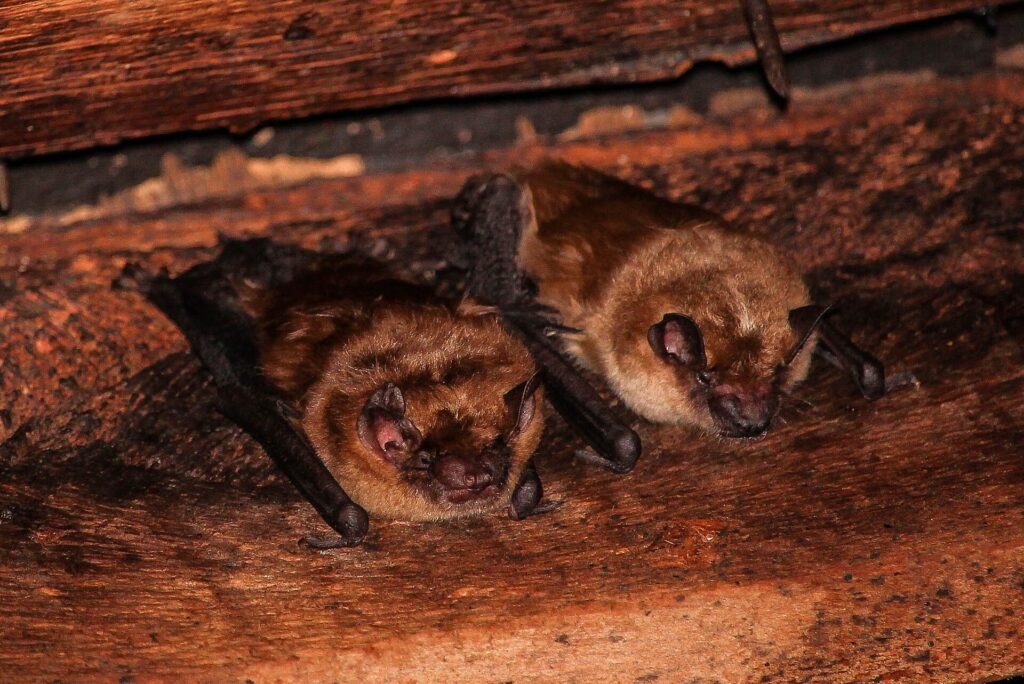
On a summer night, the air above a garden can be full of shouting you will never hear. Bats hunting insects call out constantly, at pitches far above the range of human ears, and they find their prey by listening to the echoes. It is one of the most precise hunting systems in nature. And at least one moth has worked out how to fight it with its own noise.
The Discovery Nobody Believed at First
People knew for centuries that bats could fly in total darkness. In 1793 the Italian naturalist Lazzaro Spallanzani showed that blinded bats still flew well, and soon afterwards the Swiss zoologist Charles Jurine found that bats with their ears plugged with wax crashed into things. Without equipment that could detect ultrasound, nobody could work out what the ears were hearing.
The answer came from Harvard in the late 1930s. A student named Donald Griffin brought bats to the physicist George Washington Pierce, who had built one of the few devices able to pick up sounds above the range of human hearing. Pointed at the bats, it came alive with their calls. Working with another student, Robert Galambos, Griffin showed that bats send out high-pitched pulses and use the returning echoes to sense their surroundings. In 1944 he gave the process the name it still has: echolocation.
Reading the World in Echoes
Bat calls are ultrasound, pitched above 20,000 hertz, beyond the range of human hearing. The big brown bat, for example, sweeps each call from about 65,000 down to 20,000 hertz. High-pitched sound has short wavelengths, which bounce well off small things like moths and mosquitoes.
From the echoes, a bat can work out a great deal. The delay between call and echo gives the distance. Differences between the two ears give the direction. Changes in the echo reveal the size, shape and even the texture of the target, and the slight shift in pitch caused by movement tells the bat whether the insect is flying towards or away from it.
As a bat closes in, it calls faster and faster. In the final moments of an attack, it switches to what researchers call a feeding buzz, up to about 200 calls a second, updating its picture of the target almost continuously. That rate is only possible because of specialised muscles in the bat's voice box that can contract and relax faster than almost any other muscle in a mammal.
The Moth That Fights Back
Insects have had tens of millions of years to respond. Many moths can hear bat calls and dive or twist out of the way. Some tiger moths make clicking sounds that warn bats they taste bad. One species goes further.
In 2009, Aaron Corcoran and colleagues at Wake Forest University published a study in Science on a tiger moth called Bertholdia trigona. When a bat attacks, this moth fires off rapid bursts of ultrasonic clicks from small drum-like structures on the sides of its body, called tymbals. The clicks are timed to the final stage of the bat's attack.
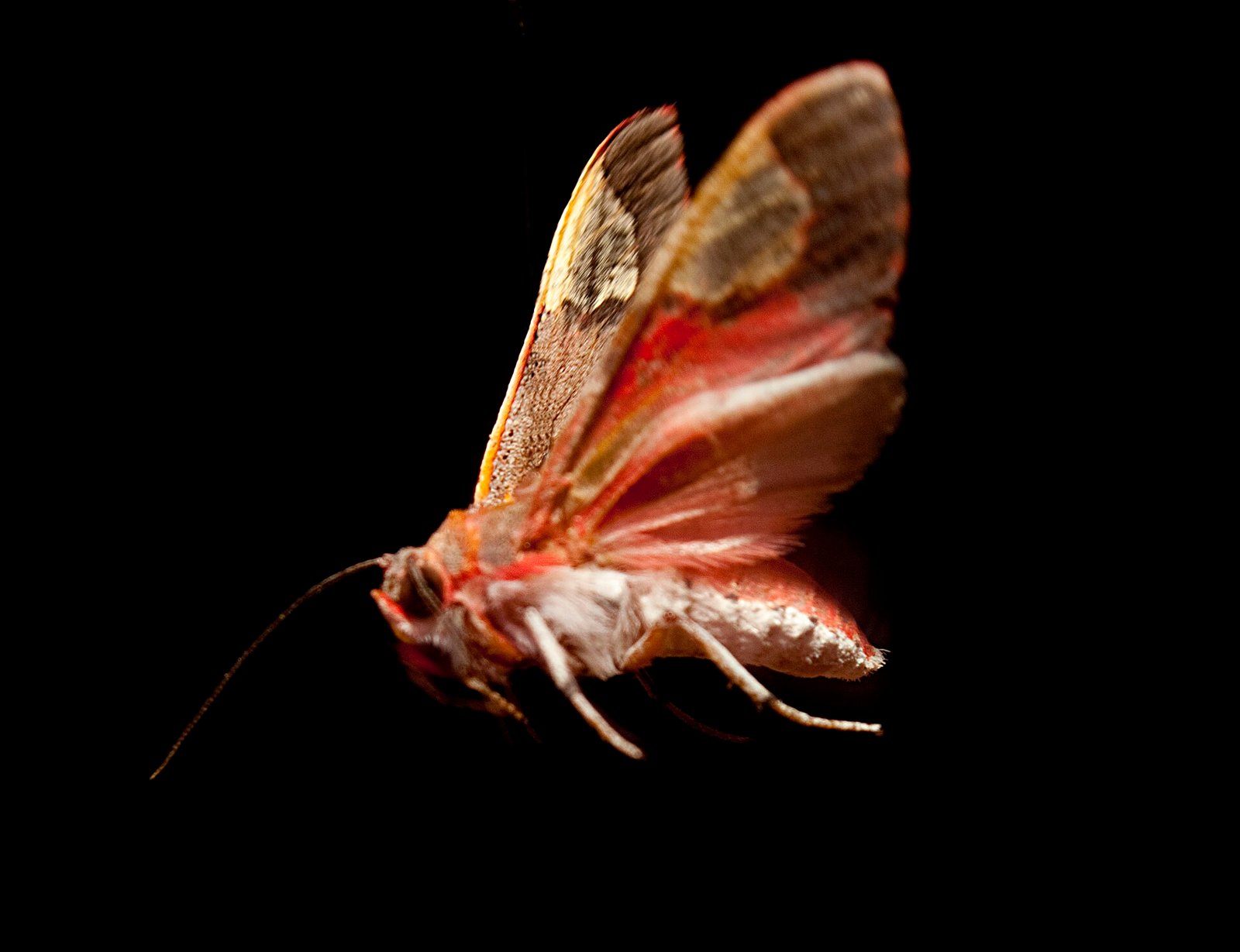
The researchers filmed big brown bats hunting these moths in a flight room with high-speed infrared cameras and ultrasonic microphones. The clicking moths were rarely caught. The bats only succeeded around one time in five, and even when the moths were tethered and could not dodge, the bats kept missing at the last moment. When the researchers silenced the moths by removing their tymbals, the bats caught them easily.
The explanation is that the clicks jam the bat's sonar. Arriving at just the moment the bat needs precise echoes, they seem to blur its sense of exactly where the moth is, so it swipes at empty air. It was the first clear evidence of an animal jamming a predator's sonar, a tactic that military engineers had used against radar long before anyone knew a moth did it too.
An Arms Race in the Dark
Bats and moths have been pushing each other's evolution for a very long time. Bats have shifted their calls in ways that are harder for moths to pick up. Moths have answered with hearing, evasive flight, warning clicks and, in at least one case, jamming. All of it happens around us on summer nights, entirely in a range of sound that we are deaf to.
Sources and Credit
- "Discovering sonar: bats," American Association for the Advancement of Science (Spallanzani and Jurine). aaas.org
- Donald R. Griffin obituary, Woods Hole Oceanographic Institution (discovery of echolocation with Robert Galambos). whoi.edu
- "Bat sounds," Museum of Biological Diversity, The Ohio State University. u.osu.edu
- "Tiger moths jam the sonar of bats," National Geographic, on Corcoran et al. in Science (2009). nationalgeographic.com
- "Bats Have Unique Superfast Squeak Muscles to Make Superfast Echolocation Calls," Popular Science (2011). popsci.com
- Featured image: Two big brown bats roosting in a crevice, by Connor Long, via Wikimedia Commons, licensed CC BY-SA 4.0. commons.wikimedia.org
- Image: A Bertholdia trigona tiger moth against a dark background, by Ajcoyote, via Wikimedia Commons, licensed CC BY-SA 3.0. commons.wikimedia.org
SAYKAYZ is a publishing platform, not a publisher of record. Any dispute over authorship or attribution is between the parties involved; please see our Terms of Service.