
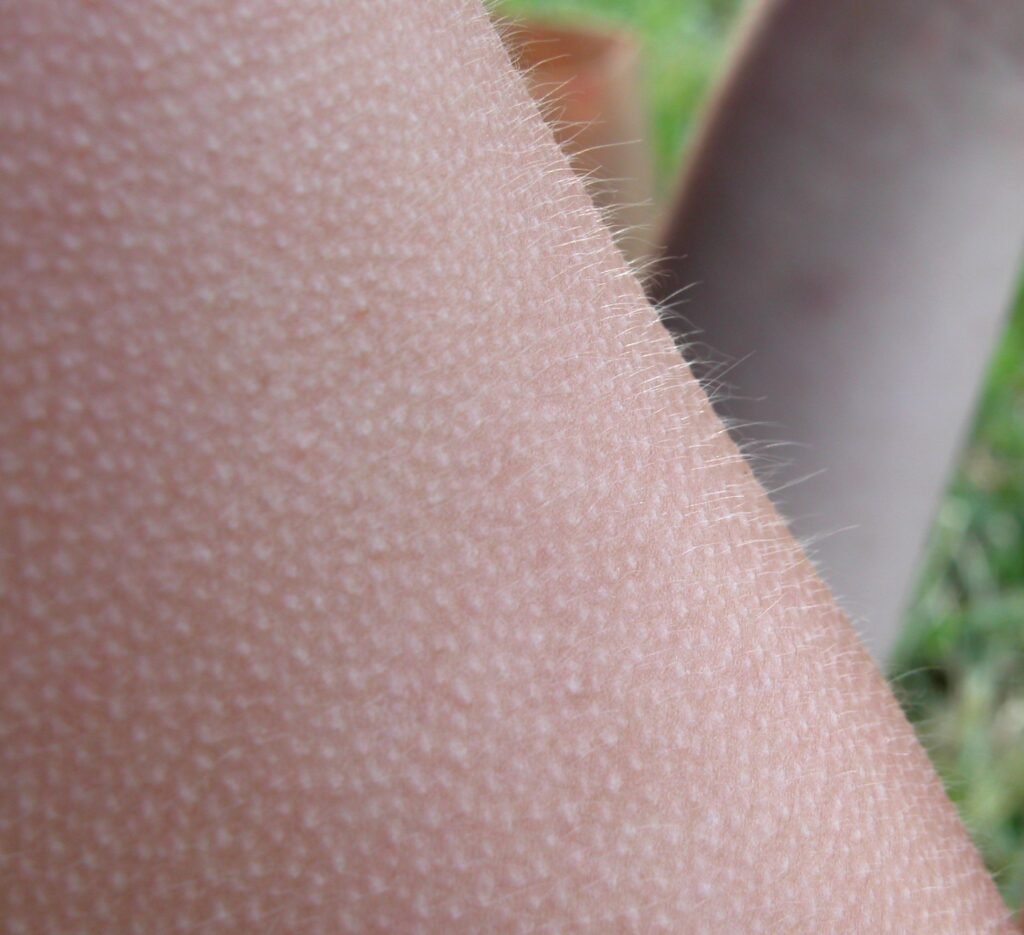
Step out into cold air, hear a piece of music that hits you just right, or get a sudden fright, and the skin on your arms tightens into tiny bumps. Goosebumps are one of the few reflexes most people can feel happening in real time. For a long time they were filed under leftovers from evolution, a trick that made sense for a furry ancestor and does nothing for a mostly hairless human. Research from Harvard suggests that is only half the story.
What Is Actually Happening
Every hair on your body grows from a follicle, a small pocket in the skin. Attached to each follicle is a tiny muscle called the arrector pili. When it contracts, it pulls the hair upright and puckers the skin around it into a bump.
The muscle is controlled by the sympathetic nervous system, the same automatic system behind the "fight or flight" response. That is why cold and strong emotions trigger goosebumps in the same way: both set off a burst of sympathetic nerve activity, and the nerve signal tells the little muscles to pull.
Why Furry Animals Need Them
For animals with thick coats, the reflex is clearly useful. Raising the hairs traps a deeper layer of still air against the skin, which works as insulation. A cat or a bird puffing up on a cold morning is doing exactly this. Raised fur also makes an animal look bigger, which is why a frightened cat bristles from head to tail and a porcupine's quills, which are modified hairs, stand up when it is threatened.
Humans have far too little body hair for either trick to matter much. So the reflex survived without an obvious job, or so it seemed.
The Hidden Job: Waking Up Hair Stem Cells
In 2020, a team led by stem cell biologist Ya-Chieh Hsu at Harvard published a study in the journal Cell that looked at what else this little system connects to. Hair follicles contain stem cells that spend long stretches resting and then wake up to grow a new hair. The researchers found that the sympathetic nerve that drives goosebumps does not stop at the muscle. Its endings wrap directly around the hair follicle stem cells, forming connections that work almost like the junctions between nerve cells.
The nerve talks to the stem cells using noradrenaline, a chemical messenger also called norepinephrine. When the researchers removed that signal in mice, the stem cells sank into a deep, long-lasting rest and hair growth suffered. The arrector pili muscle turned out to matter too, because it acts as the scaffolding that keeps the nerve in place next to the stem cells. Take the muscle away and the nerve connection falls apart.
Cold brought the whole system into focus. In the mouse experiments, prolonged cold switched on the same nerve signal, woke the stem cells and promoted new hair growth. In other words, the same chilly signal that raises goosebumps in the short term also prompts the skin to grow a thicker coat over the longer term. For a furry animal facing winter, that is a sensible pairing.
Why It Matters for People
None of this means a cold shower will cure baldness. The mouse findings show a link between the goosebump circuit and hair growth, not a ready-made treatment. But they help explain some puzzles. Earlier work found that men with pattern baldness often have shrunken or missing arrector pili muscles in the scalp, and Hsu's group has suggested that losing this nerve and muscle support could be part of why some follicles stop growing.
The study is also a neat reminder that the body rarely builds something for just one purpose. A reflex that looks like an evolutionary leftover turns out to be wired into the system that decides when hair grows. The next time you feel your skin prickle in the cold, it is the visible end of a much older conversation between your nerves and your hair.
Sources and Credit
- Shwartz, Y. et al. "Cell Types Promoting Goosebumps Form a Niche to Regulate Hair Follicle Stem Cells." Cell (2020). pubmed.ncbi.nlm.nih.gov
- "Getting goose bumps could boost hair growth," Science News. sciencenews.org
- "What goosebumps are for," NIH Research Matters, National Institutes of Health. nih.gov
- Featured image: Close-up of goosebumps on a person’s arm, by Ildar Sagdejev (Specious), via Wikimedia Commons, licensed CC BY-SA 3.0. commons.wikimedia.org
SAYKAYZ is a publishing platform, not a publisher of record. Any dispute over authorship or attribution is between the parties involved; please see our Terms of Service.