
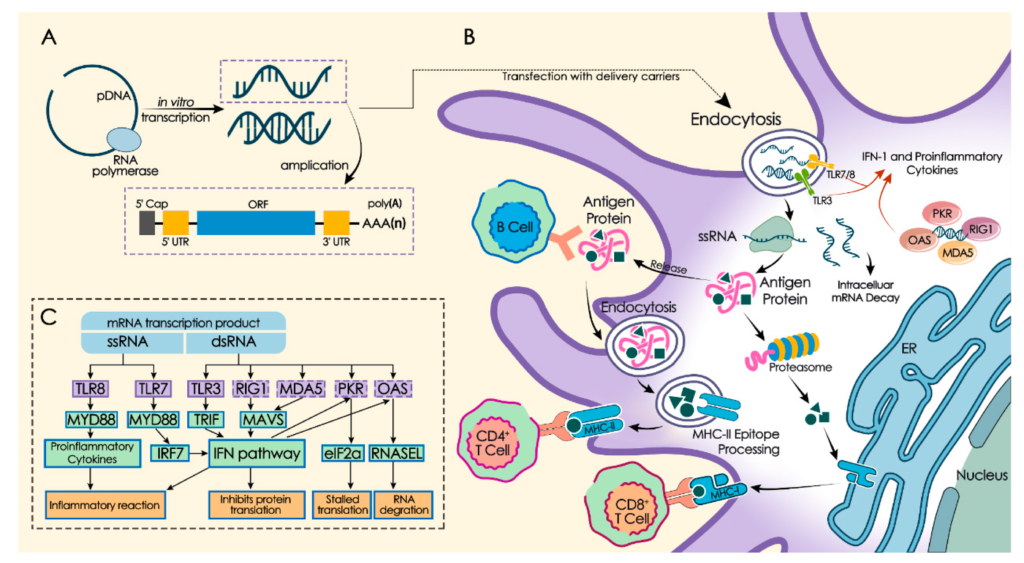
Traditional vaccines work by showing your immune system a weakened or dead version of a pathogen, or a piece of one, and letting the body learn to recognize it. mRNA vaccines skip that step entirely. Instead of delivering the target itself, they deliver a set of instructions and let your own cells manufacture a harmless piece of it on the spot. It sounds like a strange workaround, hand the construction manual to the body instead of the finished part, but it’s precise, fast to redesign for a new pathogen, and it doesn’t involve growing any live virus at all. Getting there took decades of work that almost didn’t survive early skepticism.
A Message, Not a Virus
Messenger RNA, mRNA, is the molecule cells already use internally to carry genetic instructions from DNA in the nucleus out to the ribosomes, the cellular machinery that builds proteins. An mRNA vaccine hijacks that existing, completely normal cellular process. Scientists design a synthetic strand of mRNA that codes for one specific piece of a pathogen, in the case of the COVID-19 vaccines, the spike protein found on the surface of the SARS-CoV-2 virus. Once inside a cell, the mRNA gets read by the cell’s own ribosomes exactly the way any other mRNA would, producing copies of that one protein fragment. The fragment alone is harmless, it’s just a shape, not a functioning virus, but it’s enough for the immune system to notice, study, and build a defense against. The mRNA itself is fragile and short-lived. Cells break it down within days, and it never enters the nucleus or interacts with the body’s own DNA.
Getting the Message Into the Cell
Bare mRNA is a fragile molecule that degrades almost instantly in the human body and can’t cross a cell membrane on its own. The solution that made mRNA vaccines actually usable was the lipid nanoparticle, a microscopic bubble of fat molecules that wraps around the mRNA strand, shielding it from being broken down before it reaches a cell and helping ferry it through the cell membrane once it arrives. Without this delivery system, the underlying mRNA technology would be scientifically interesting and clinically useless. The nanoparticle is arguably doing as much of the practical work as the mRNA payload itself.
The Discovery That Almost Didn’t Happen
For years, injecting synthetic mRNA into the body triggered a strong, nonspecific inflammatory response, because the immune system’s innate defenses are wired to recognize foreign RNA as a signature of viral infection and attack it before it can do anything useful. That reaction made early mRNA therapeutics look like a dead end, and the research behind it was repeatedly rejected for funding and publication through the 1990s. The breakthrough came from biochemist Katalin Kariko and immunologist Drew Weissman, working together at the University of Pennsylvania. In 2005 they found that replacing one of mRNA’s four standard building blocks, uridine, with a modified version called pseudouridine let the synthetic mRNA slip past the immune system’s early-warning detectors without triggering that inflammatory shutdown, while still being read normally by the ribosome, and in some cases translated even more efficiently. That single modification, largely ignored by mainstream funding bodies for years afterward, turned out to be the missing piece that made mRNA vaccines viable in humans. Kariko and Weissman were jointly awarded the 2023 Nobel Prize in Physiology or Medicine for the discovery.
A Platform, Not Just a Product
What makes mRNA technology different from older vaccine approaches isn’t just speed, though that mattered enormously during COVID-19, when candidate vaccines moved from genetic sequence to clinical trials in a fraction of the time older platforms required. It’s that the platform is fundamentally reprogrammable. Switching the target from one pathogen’s protein to another’s is, at the molecular level, mostly a matter of swapping which genetic sequence gets encoded into the mRNA strand, not rebuilding the entire manufacturing and delivery process from scratch. That reprogrammability is why mRNA technology is now being explored well beyond infectious disease, including in early-stage cancer vaccine research, where the same basic mechanism, delivering instructions rather than a finished product, is being aimed at getting the immune system to recognize a patient’s own tumor cells. The instructions changed. The trick the body’s ribosomes are being asked to perform stays exactly the same.
Sources & Credit
- “The Nobel Prize in Physiology or Medicine 2023,” Nobel Prize Advanced Information. nobelprize.org
- “Press release: The Nobel Prize in Physiology or Medicine 2023,” NobelPrize.org. nobelprize.org
- “mRNA nanomedicines scoop Nobel Prize in Physiology or Medicine,” EMBL. embl.org
- “Scientists behind mRNA COVID Vaccines Win 2023 Nobel Prize in Physiology or Medicine,” Scientific American. scientificamerican.com
- Featured image: diagram of mRNA vaccine mechanism, by Shuqin Xu, Kunpeng Yang, Rose Li, and Lu Zhang, via Wikimedia Commons, licensed CC BY 4.0. commons.wikimedia.org
SAYKAYZ is a publishing platform, not a publisher of record. Any dispute over authorship or attribution is between the parties involved; please see our Terms of Service.