
Poison Dart Frogs Don’t Make Their Own Poison. Here’s Where It Actually Comes From
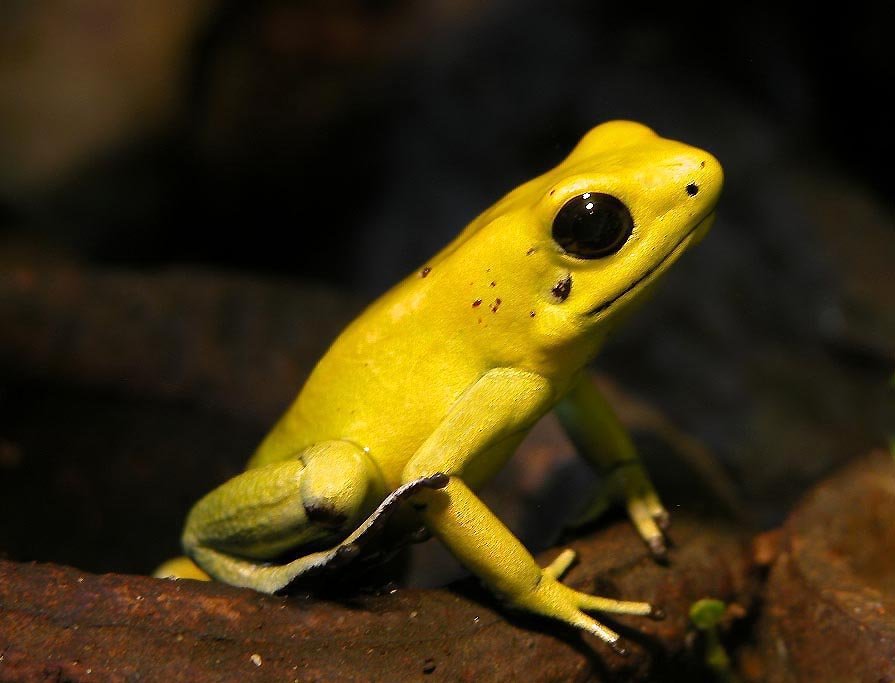
Some poison dart frogs carry enough toxin in their skin to kill several adult humans, all packed into an animal small enough to sit on a fingertip. It’s tempting to picture some kind of internal venom factory, glands quietly synthesizing lethal compounds from scratch. That’s not what’s happening. Take a poison dart frog out of the wild, raise it in captivity on a different diet, and within a couple of generations it stops being poisonous at all. The toxin was never the frog’s own invention. It was borrowed, piece by piece, from what the frog eats.
Toxic by Diet, Not by Design
The compounds responsible for a wild poison dart frog’s toxicity, a family of alkaloids that includes the extraordinarily potent batrachotoxin found in a handful of Phyllobates species, aren’t produced by the frog’s own metabolism. The frogs are sequestering them, meaning they eat small arthropods, particularly certain species of ants, mites, and beetles, that already contain these toxic alkaloids, and the frog’s skin glands take those compounds in essentially unchanged and store them, ready to be secreted as a defense if something tries to eat the frog. The ultimate source traces back further still, since many of these arthropods likely picked up the toxins from plants or fungi in their own diet. The frog sits at the end of a chain, concentrating toxins that originated somewhere else in the rainforest food web entirely.
The Experiment That Proved It
The researcher most responsible for working this out was John Daly, a chemist at the U.S. National Institutes of Health who spent decades studying dendrobatid frog toxins after first isolating and naming batrachotoxin in the 1960s from Phyllobates aurotaenia. Daly’s group ran a direct test of the diet hypothesis: they took captive-bred poison dart frogs that had grown up with no skin toxins at all, since captive diets of fruit flies, crickets, and mealworms don’t contain the relevant alkaloids, and fed them arthropods loaded with those compounds. The frogs began secreting the same toxic alkaloids from their skin, unchanged from how they’d been ingested. Daly summarized the finding plainly: dendrobatid frogs raised in captivity, without access to their natural wild diet, come up with no detectable skin alkaloids whatsoever. Every reptile keeper and zoo that houses these frogs today relies on exactly this fact. A captive-bred poison dart frog fed standard feeder insects is, for all practical purposes, not dangerous to handle.
How the Frog Survives Its Own Poison
There’s a second puzzle sitting inside the first one: if a frog is storing enough batrachotoxin in its skin to be lethal to nearly anything that touches it, how does it not poison itself first. Batrachotoxin works by locking open sodium channels in nerve and muscle cells, and those channels are just as present in a poison dart frog’s own body as in whatever predator might attack it. Researchers initially proposed a tidy explanation: a single point mutation in the frog’s own sodium channel protein that makes it resistant to the toxin’s effects, similar to resistance mutations found in some other toxin-bearing animals. More recent research has complicated that story. When scientists tested the sodium channels of these frogs directly, several species turned out to still be sensitive to batrachotoxin at the channel level, mutation or not, and captive-raised frogs with the same sensitive channels showed no ill effects from carrying toxins at all, since they simply don’t have any in their system to begin with. The more current leading explanation involves separate “toxin sponge” proteins in the frog’s bloodstream, like one called saxiphilin, that appear to bind and neutralize circulating toxin molecules before they can reach and disrupt the sensitive channels. The full picture of self-resistance is still being actively worked out.
A Borrowed Weapon, Not a Built One
What makes the poison dart frog story compelling isn’t really the toxicity itself, it’s how contingent that toxicity turns out to be. Take away the specific ants and mites a wild population happens to feed on, and you take away the poison entirely, with nothing in the frog’s own biology stepping in to replace it. The frog didn’t evolve a chemical weapons factory. It evolved the far more efficient trick of finding something dangerous already present in its environment and figuring out how to carry it around safely. The danger was always out there in the leaf litter first. The frog just learned how to wear it.
Sources & Credit
- “Why Poison Dart Frogs Raised in Captivity Lose Their Toxicity,” Today I Found Out. todayifoundout.com
- “Single mutation keeps lethal frog from poisoning itself,” Chemistry World. chemistryworld.com
- “Sodium channel toxin-resistance mutations do not govern batrachotoxin (BTX) autoresistance in poison birds and frogs,” bioRxiv. biorxiv.org
- “Here’s Why These Horribly Deadly Poison Dart Frogs Never Poison Themselves,” ScienceAlert. sciencealert.com
- Featured image: golden poison frog (Phyllobates terribilis), by Wilfried Berns, via Wikimedia Commons, licensed CC BY-SA 2.0 DE. commons.wikimedia.org
SAYKAYZ is a publishing platform, not a publisher of record. Any dispute over authorship or attribution is between the parties involved; please see our Terms of Service.