
The Strangler Fig: The Rainforest Tree That Starts by Killing Its Host
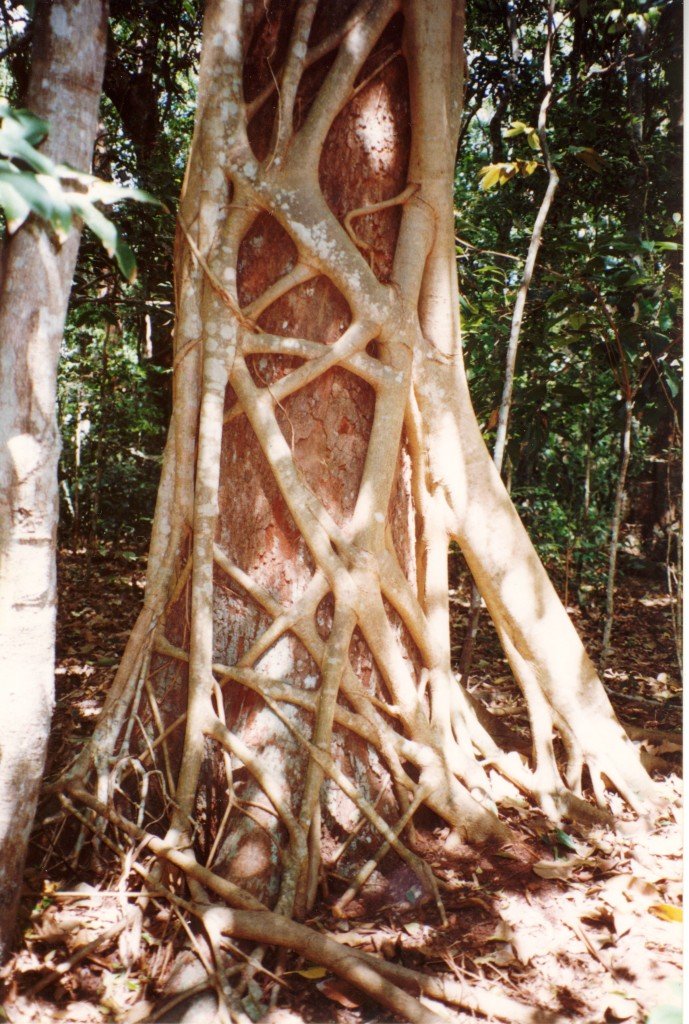
Walk into a mature rainforest and you’ll eventually find one: a massive, lattice-like trunk, made of what looks like dozens of woody cables fused together, sometimes with a hollow center you could stand inside. That’s a strangler fig, and it earned its Spanish nickname, matapalo, “tree killer,” honestly. It didn’t start life as a towering giant with its roots in the soil. It started as a single seed, dropped in a bird’s droppings, sixty feet up in the crown of a completely different tree.
A Seed That Starts in the Wrong Place
Strangler figs begin life as epiphytes, plants that germinate not in soil but perched on another plant. A bird, bat, or monkey eats a fig fruit somewhere in the canopy and later deposits the seeds, undigested, in the crook of a branch or a crevice in a host tree’s bark, often high above the forest floor. That’s a strange place for a seedling to end up, but it comes with one major advantage: sunlight. In a dense rainforest, the canopy is where the light is, and most trees have to spend decades pushing a trunk up through the shaded understory to reach it. A fig seed germinating in the canopy skips that entire struggle.
Growing in Two Directions at Once
From that perch, the young fig grows the way you’d expect above ground, sending out leaves and branches, but its roots do something more unusual. They grow downward along the outside of the host tree’s trunk, sometimes as thin, searching strands, reaching for the forest floor many meters below. Once those roots touch soil, everything accelerates. With access to real ground water and nutrients, the fig can grow far faster than it could as a canopy-bound epiphyte, and the descending roots keep thickening and multiplying, gradually wrapping and fusing around the host’s trunk in the netted, cage-like pattern strangler figs are known for.
Not Strangulation in the Violent Sense
The name suggests something quick and dramatic, but the actual process is closer to a slow siege than a strangling. As the fig’s root lattice thickens around the host trunk, it does physically constrict the trunk, and it also competes directly with the host’s own root system underground for water and nutrients. Above ground, the fig’s own canopy, growing from that original high branch, keeps expanding and can eventually overtop the host’s crown entirely, cutting off much of its light. Over years or decades, some combination of physical constriction, resource competition, and shading can kill the host tree outright. In other cases the host simply dies of old age or disease on its own timeline, and the fig’s root cage is already there to keep standing once the original trunk inside it rots away, leaving the hollow, lattice-walled trunk rainforest visitors sometimes find.
A Killer That the Forest Depends On
Here’s the part that complicates the “tree killer” framing: mature strangler figs are considered a keystone species in many tropical forests, meaning an outsized number of other species depend on them specifically. Fig trees fruit on irregular schedules that don’t sync with other rainforest trees, and during lean stretches of the year when little else is producing fruit, a single fruiting fig can be one of the only food sources available across an entire patch of forest, drawing in birds, bats, monkeys, and insects from a wide area. The same hollow trunks and root cavities left behind after a host tree decays become shelter for bats, birds, and a long list of smaller animals that would otherwise have nowhere comparable to live. A forest missing its strangler figs tends to lose a disproportionate amount of the wildlife that depends on that irregular, reliable fruiting.
That’s the real shape of the strangler fig’s story. It isn’t a villain plant picking off healthy trees for sport, and it isn’t a passive freeloader either. It’s a species that solved the problem of getting to the light first and paying for it later, one that happens to kill the very structure it depended on to get started, and then spends the rest of its long life quietly holding up a disproportionate share of everything living around it.
Sources & Credit
- “Strangler figs: Killers or bodyguards?” Royal Botanic Gardens, Kew. kew.org
- “Trees with a Difference: The Strangler Figs,” Resonance, Indian Academy of Sciences. ias.ac.in
- “Strangler Fig,” World Rainforests. worldrainforests.com
- Featured image: strangler fig (Ficus watkinsiana) wrapped around its host tree, by Peter Woodard, via Wikimedia Commons, public domain. commons.wikimedia.org
SAYKAYZ is a publishing platform, not a publisher of record. Any dispute over authorship or attribution is between the parties involved; please see our Terms of Service.