
A blue whale never sets foot on land, never breathes anything but ocean air through a hole in the top of its head, and gives birth entirely submerged. It’s about as fully aquatic as a mammal can get. And yet the fossil record, backed up independently by DNA, says its ancestors fifty million years ago were four-legged land animals walking around on hooves. Not swimming animals that eventually grew legs, the reverse. A land mammal that gradually gave up land altogether. The chain of fossils connecting those two endpoints is one of the more complete transitional sequences in all of paleontology.
Starting With Teeth, Not Legs
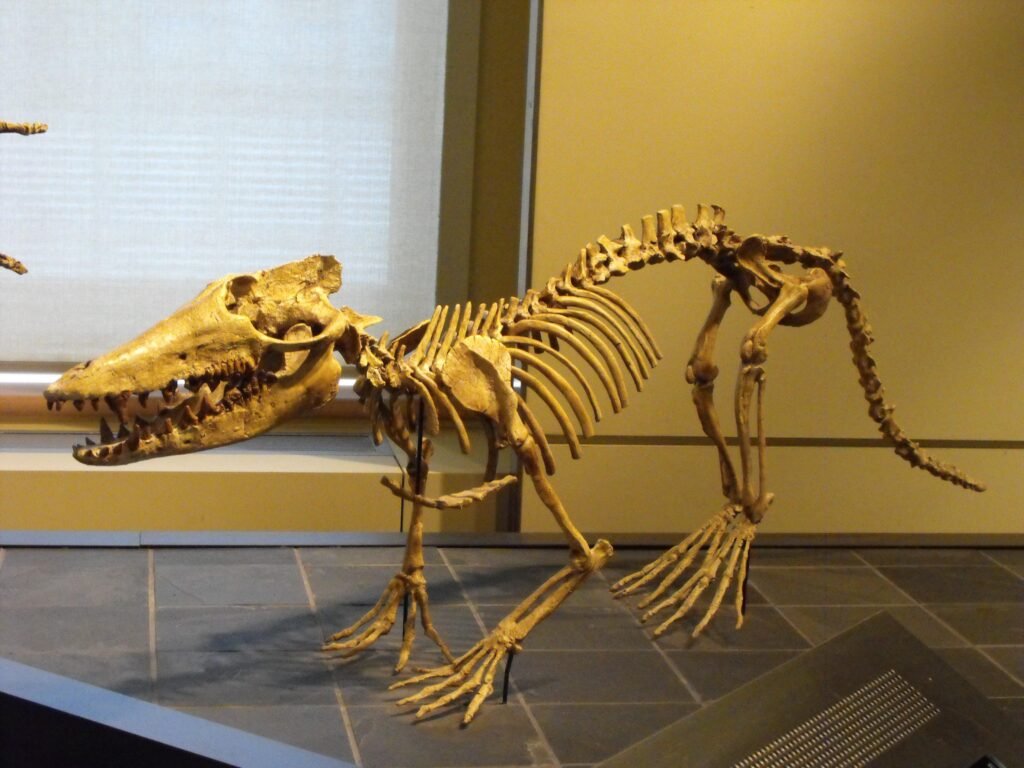
The first serious clue wasn’t a skeleton, it was teeth. In 1978, an expedition working in Pakistan turned up teeth and a partial skull from a 50-million-year-old animal so unfamiliar that researchers weren’t initially sure they were even looking at a whale ancestor. It was named Pakicetus in 1981. Its skull had the specialized ear structure found only in whales, the trait that let paleontologists confidently place it in the cetacean lineage, but the rest of the animal looked nothing like a whale. Pakicetus was a land-dwelling, four-legged creature, likely living near rivers or shorelines, with ears not yet adapted for the directional underwater hearing that every later whale depends on to feed and communicate. It’s the starting point of the whole sequence, whale in name only.
Legs That Slowly Stop Being Legs
From there, the fossil record tracks a fairly steady progression toward water. Ambulocetus, nicknamed the “walking whale,” lived around the same general period and shows a more amphibious build than Pakicetus, with shortened legs, enlarged, paddle-like hands and feet, and a long, powerfully muscled tail suited to swimming. Rodhocetus, known from partial skeletons, goes further still, with short limbs and elongated hands and feet that were likely webbed rather than built for walking on land. Later members of this same lineage, grouped as protocetids, kept legs and functioning ankles similar to modern land ungulates like sheep and deer, but were spending most of their time in water, some still coming ashore only to give birth. By the time Basilosaurus appears in the fossil record, the transformation is nearly complete: an animal that was clearly, unambiguously a whale, fully aquatic, but still carrying small hind legs, feet, and toes attached to a pelvis that no longer connected to the spine. Vestigial, functionally useless for walking, but still there, a physical leftover of the land-dwelling ancestors a few million years back.
What DNA Adds to the Story
Fossils alone gave paleontologists the shape of this transition, but a separate line of evidence, DNA comparison between whales and living land mammals, ended up pointing to an unexpected close relative: the hippopotamus. Molecular studies comparing mitochondrial, nuclear, and ribosomal DNA found whales nested surprisingly close to hippos within the broader group of even-toed ungulates. The most convincing version of this evidence isn’t just sequence similarity, it’s shared retroposon insertions, specific short stretches of DNA that get randomly inserted into a genome at essentially random locations. Finding the exact same insertion, in the exact same spot, in two separate lineages is statistically almost impossible unless both lineages inherited it from a shared ancestor. Whales and hippos share several of these markers. For years this molecular finding sat somewhat awkwardly next to the fossil record, since no fossil directly linked the two groups. That gap closed with the discovery of extinct semiaquatic ungulates related to early hippos, animals that lived worldwide for tens of millions of years before dying out, which turned out to be the missing physical link the DNA had already predicted.
A Transition, Not a Leap
None of this happened in some dramatic single event. It took roughly eight to ten million years, a long stretch by human standards but genuinely fast in evolutionary terms, for a land-walking ancestor to become a fully committed ocean animal. Every step along that path, the shrinking legs, the migrating ear structures, the shift from walking limbs to paddles, still shows up as a working animal in the fossil record, not a hypothetical missing link. The blue whale gliding through open ocean today, breathing air, nursing its calf, never once touching solid ground, is carrying every one of those intermediate stages inside its own body plan, right down to the tiny disconnected hip bones that no longer do anything except confirm where it came from.
Sources & Credit
- “Evolution of Whales from Land to Sea,” University of Michigan Museum of Paleontology. lsa.umich.edu
- “The evolution of whales,” UC Berkeley Understanding Evolution. evolution.berkeley.edu
- “The Origin of Whales and the Power of Independent Evidence,” National Center for Science Education. ncse.ngo
- “Scientists find missing link between the whale and its closest relative, the hippo,” Phys.org. phys.org
- Gatesy, J. et al. “Phylogenetic relationships among cetartiodactyls… Hippopotamuses are the closest extant relatives of whales.” PNAS 96(18), 10261-10262 (1999). pnas.org
- Featured image: Pakicetus skeletal reconstruction, by Kevin Guertin, via Wikimedia Commons, licensed CC BY-SA 2.0. commons.wikimedia.org
SAYKAYZ is a publishing platform, not a publisher of record. Any dispute over authorship or attribution is between the parties involved; please see our Terms of Service.