
Tardigrades: The Animal That Can Survive Being Dried, Frozen, and Blasted With Radiation
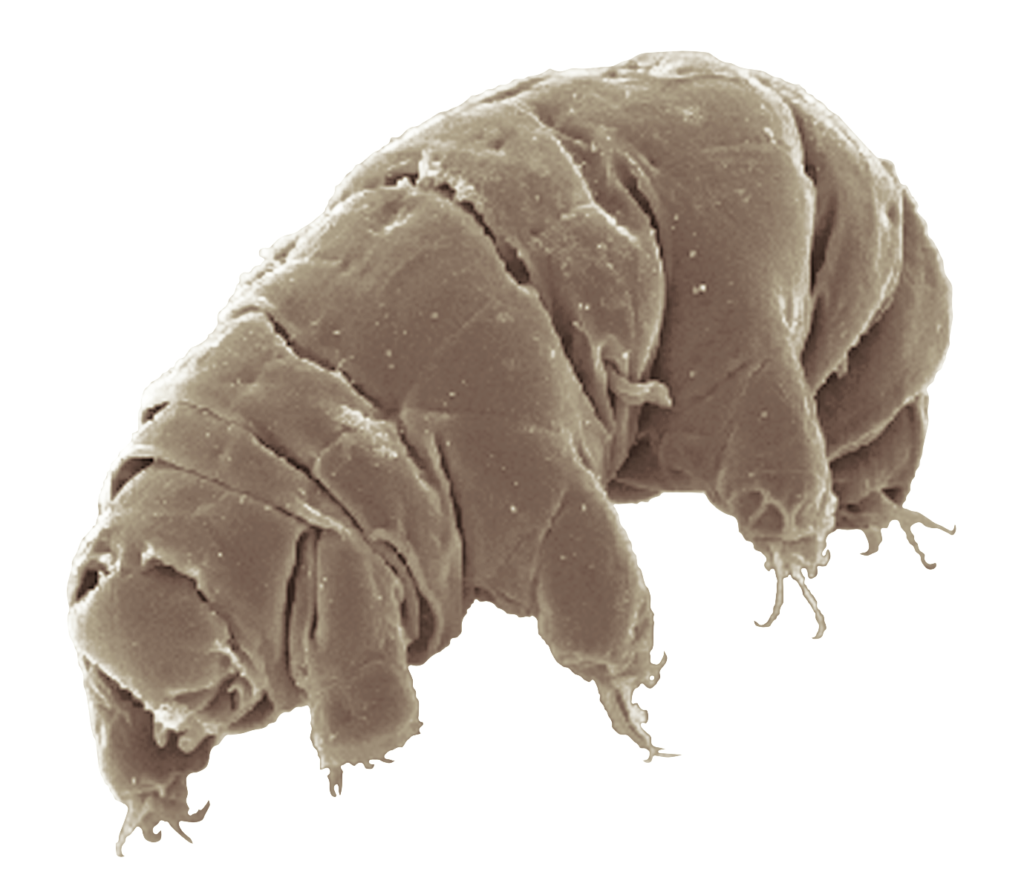
Most animals die if you take away their water for more than a few days. Tardigrades, eight-legged creatures smaller than a grain of rice, can lose almost all of theirs, sit shriveled and lifeless for years, then rehydrate and walk away. They’ve been boiled, frozen to nearly absolute zero, crushed under pressures found in the deepest ocean trenches, and shot into the vacuum of space. A meaningful number survive every single time. The reason isn’t magic, it’s a specific set of molecular tricks that biologists are only now starting to fully map out.
Turning Into a Tun
The core of a tardigrade’s survival strategy is a process called cryptobiosis, a state where its metabolism drops so low it becomes essentially undetectable. When conditions turn hostile, usually through drying out, a tardigrade pulls its head and legs in, contracts its body along its own axis, and expels most of the water inside its cells. What’s left is a shriveled little barrel called a tun. In this state, the animal isn’t really alive in any active sense, but it isn’t dead either. It’s paused. Rehydrate it, sometimes decades later, and the legs come back out and it starts walking again like nothing happened.
What’s Actually Protecting the Cells
Losing water should be catastrophic for a cell. Without it, proteins misfold, membranes collapse, and DNA is left exposed to damage. Tardigrades get around this with a handful of specialized molecules. One is trehalose, a sugar that some tun-forming tardigrade species produce, which appears to help stabilize cell membranes and proteins as water disappears, essentially acting as a chemical stand-in for the water molecules that would normally hold those structures in shape. The more striking discovery came out of genome sequencing work on the species Ramazzottius varieornatus, which turned up a protein unique to tardigrades called Dsup, short for “damage suppressor.” Dsup binds directly to the DNA packed inside the nucleus and appears to physically shield it from reactive hydroxyl radicals, the highly destructive byproducts that radiation and oxidative stress generate inside a cell. When researchers inserted the gene for Dsup into human cells grown in a lab, those cells showed roughly 40 percent less DNA damage from radiation exposure than cells without it, and better overall survival.
Surviving Actual Space
The clearest demonstration of what all this machinery can do came in September 2007, when the European Space Agency sent dehydrated tardigrades into orbit aboard the Foton-M3 mission as part of an experiment called TARDIS. Around 3,000 tardigrades, already in their tun state, were mounted on an external platform and exposed directly to the vacuum of space for ten days. Some were shielded from radiation entirely, some were exposed to specific bands of ultraviolet light, and some got the full unfiltered blast, which at that altitude runs about a thousand times stronger than UV exposure at sea level on Earth. Before this experiment, no animal had ever been shown to survive the vacuum of space and full solar radiation at the same time. When the samples came back down and were rehydrated, a meaningful portion of the tardigrades revived within half an hour, and some of the survivors went on to lay eggs that hatched normally.
Impressive, Not Invincible
It’s worth being precise about what this does and doesn’t mean, because tardigrade coverage tends to drift into exaggeration. They are not indestructible, and they are not thriving in space, they’re surviving a brief, specific kind of exposure in a dormant, dried-out state that most animals can’t enter at all. A hydrated, active tardigrade is about as fragile as any other small invertebrate. The tun state is the entire trick, and it only works for stresses the tardigrade can shut itself down against. What makes them worth studying isn’t that they’re some invincible extremophile out of science fiction, it’s that a real, working biological system for protecting cells from total desiccation and radiation damage exists in nature, and pieces of it, like Dsup, can be borrowed and tested in other organisms. That’s the part with actual stakes, not for the tardigrades, but for anything trying to protect cells that weren’t built to survive what tardigrades survive routinely.
Sources & Credit
- Hashimoto, T., Horikawa, D.D., et al. “Extremotolerant tardigrade genome and improved radiotolerance of human cultured cells by tardigrade-unique protein.” Nature Communications 7, 12808 (2016). nature.com
- Jönsson, K.I., Rabbow, E., Schill, R.O., Harms-Ringdahl, M., Rettberg, P. “Tardigrades survive exposure to space in low Earth orbit.” Current Biology 18, R729-R731 (2008). doi.org
- “Tiny animals survive exposure to space,” European Space Agency. esa.int
- “Molecular basis of radiation resistance in tardigrades and the medical implications.” World Journal of Radiology. pubmed.ncbi.nlm.nih.gov
- Featured image: SEM image of Milnesium tardigradum, by Schokraie E, Warnken U, Hotz-Wagenblatt A, Grohme MA, Hengherr S, et al. (2012), via Wikimedia Commons, licensed CC BY 2.5. commons.wikimedia.org
SAYKAYZ is a publishing platform, not a publisher of record. Any dispute over authorship or attribution is between the parties involved; please see our Terms of Service.