
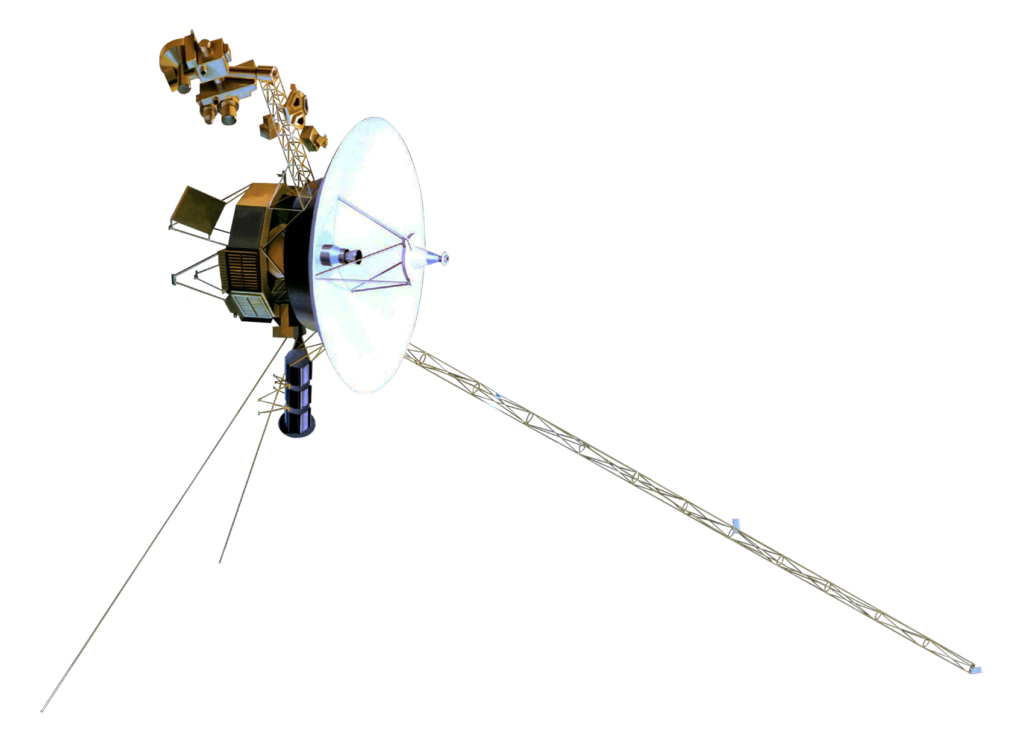
Voyager 1 launched in 1977 to study Jupiter and Saturn up close. Nearly fifty years later, it’s still transmitting, still returning real scientific data, and it’s now so far away that a radio signal traveling at the speed of light takes most of a full day to reach it. No human-made object has ever gone farther, and what it found on the way out of the solar system settled a genuine scientific mystery that had nothing to do with its original mission.
Crossing the Edge of the Sun’s Bubble
The Sun doesn’t just illuminate space, it fills the region around it with a constant outward stream of charged particles called the solar wind, inflating a vast bubble known as the heliosphere. Voyager 1 crossed the outer boundary of that bubble, called the heliopause, on August 25, 2012, at roughly 121.6 astronomical units from the Sun, about 121 times the distance from the Sun to Earth. That made it the first spacecraft to reach interstellar space, the region between stars.
Confirming the crossing wasn’t simple. Voyager’s plasma density instrument had actually failed years earlier, so NASA couldn’t directly measure the particle density around the spacecraft to check whether it had really left the heliosphere. The proof came almost by accident, in April and May of 2013, when a burst of solar activity sent a shockwave outward that reached Voyager and caused the surrounding plasma to vibrate. Those vibrations let scientists calculate the plasma’s density indirectly, and it was about 40 times denser than inside the heliosphere, matching exactly what interstellar space should look like. NASA didn’t announce the crossing publicly until roughly 13 months after it happened, while the team worked through internal debate over what the data actually showed.
Where It Is Now
As of 2026, Voyager 1 is about 15.8 billion miles from Earth, close to 170 astronomical units out. On November 18, 2026, it’s set to cross one light-day from Earth, the point where a signal traveling at light speed takes a full 24 hours to arrive. The spacecraft runs on a radioisotope power source that has been slowly decaying since launch, and NASA has been shutting down instruments one by one to stretch what power remains. By April 2026, only two science instruments were still active, and NASA switched off the Low-Energy Charged Particles instrument that same month to conserve power for the others. Engineers still expect to keep at least one instrument returning data into the 2030s.
Interstellar Space Isn’t the Same as Leaving the Solar System
It’s a common mix-up, and understandable. Voyager 1 left the heliosphere in 2012, but the solar system itself extends much farther, out to the Oort Cloud, a distant shell of icy bodies still gravitationally bound to the Sun. Voyager won’t reach the inner edge of the Oort Cloud for roughly another 300 years, and it would take tens of thousands of years to pass all the way through it. Interstellar space and “outside the solar system” turn out to be very different boundaries, and Voyager has only crossed the nearer one.
Sources and Credit
- NASA JPL, “Voyager 1 Helps Solve Interstellar Medium Mystery.” jpl.nasa.gov
- NASA Science, “Interstellar Mission.” science.nasa.gov
- Marx, W., Nadworny, E. “The Little Probe That Could: Why Voyager 1 Matters, and Why NASA Just Switched Part of It Off,” NPR, April 2026. npr.org
- Strickland, A. “Voyager 1 will reach one light-day from Earth in 2026. Here’s what that means.” CNN. kesq.com
SAYKAYZ is a publishing platform, not a publisher of record. Any dispute over authorship or attribution is between the parties involved; please see our Terms of Service.