
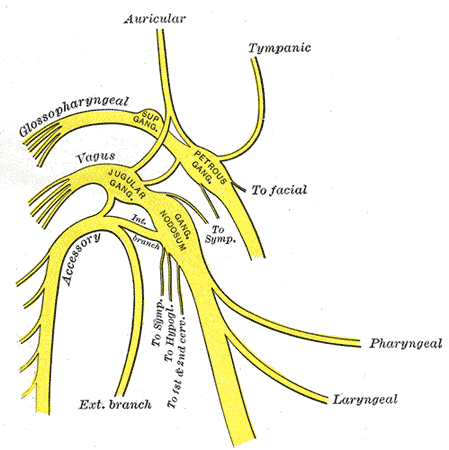
The vagus nerve doesn’t get talked about much outside of anatomy class, which is strange given what it actually does. It’s the longest cranial nerve in the body, running from the base of the brainstem down through the neck, wrapping around the heart and lungs, and ending in the gut. Its name comes from the Latin word for “wandering,” and wandering is exactly what it does. No other nerve touches this many organs.
Mostly One-Way Traffic, and Not the Way You’d Guess
The intuitive assumption is that the brain uses the vagus nerve to send instructions down to the body. It does some of that, releasing a chemical called acetylcholine that helps drive digestion by triggering the wave-like muscle contractions that move food through the gut. But that’s the minority function. Somewhere between seventy and eighty percent of the vagus nerve’s fibers actually carry signals the other direction, from the gut and other organs up to the brain. Most of what travels this nerve isn’t the brain talking to the body. It’s the body reporting back.
That’s the physical basis of what’s called the gut-brain axis, a two-way communication network between the digestive system and the brain that researchers now think shapes mood and stress response more than anyone assumed a couple of decades ago. Bacteria living in the gut produce some of the same neurotransmitters the brain uses, and there’s growing evidence those signals travel up the vagus nerve and genuinely influence brain activity, not just digestion.
The Nerve That Talks to the Immune System
The most surprising vagus nerve finding didn’t come from neuroscience at all. In 2000, a research team led by Kevin Tracey showed that electrically stimulating the vagus nerve in rats could prevent septic shock, a runaway, often fatal immune overreaction. The mechanism turned out to be direct: vagal signals trigger the release of acetylcholine near immune cells called macrophages, and that acetylcholine suppresses their production of a major inflammatory molecule called TNF-alpha. Tracey named this the cholinergic anti-inflammatory pathway, and it was the first solid evidence of a direct, fast-acting wire between the nervous system and the immune system, not just a slow hormonal connection.
That discovery is now the basis for real experimental treatments. Implantable vagus nerve stimulators, devices originally developed for epilepsy, are being tested for inflammatory bowel disease and rheumatoid arthritis, conditions where the immune system’s inflammatory response has essentially gotten stuck in the “on” position.
Vagal Tone and Why It’s Not Just Wellness Talk
“Vagal tone” shows up constantly in wellness content, usually attached to breathing exercises, and it’s easy to dismiss as vague self-help language. The underlying concept is real. Vagal tone refers to how efficiently the vagus nerve regulates the body’s stress response, essentially how quickly your heart rate and physiology can shift between alert and calm states. Higher vagal tone correlates with better emotional regulation and resilience to stress, and it can be measurably increased through slow, deep breathing, which is one of the few voluntary ways a person can directly influence this nerve.
What makes the vagus nerve worth knowing about isn’t any single function. It’s that a single nerve wanders through nearly every major system in the body, carrying more information up than down, and turns out to be a genuine, physical link between digestion, mood, and immune response, systems that used to be studied as though they had nothing to do with each other.
Sources and Credit
- Cleveland Clinic, “Vagus Nerve: What It Is, Function, Location and Conditions.” my.clevelandclinic.org
- Cleveland Clinic, “What To Know About the Gut-Brain Connection.” my.clevelandclinic.org
- Tracey, K.J. et al., research establishing the cholinergic anti-inflammatory pathway, 2000; overview via PMC/NIH. pmc.ncbi.nlm.nih.gov
SAYKAYZ is a publishing platform, not a publisher of record. Any dispute over authorship or attribution is between the parties involved; please see our Terms of Service.