
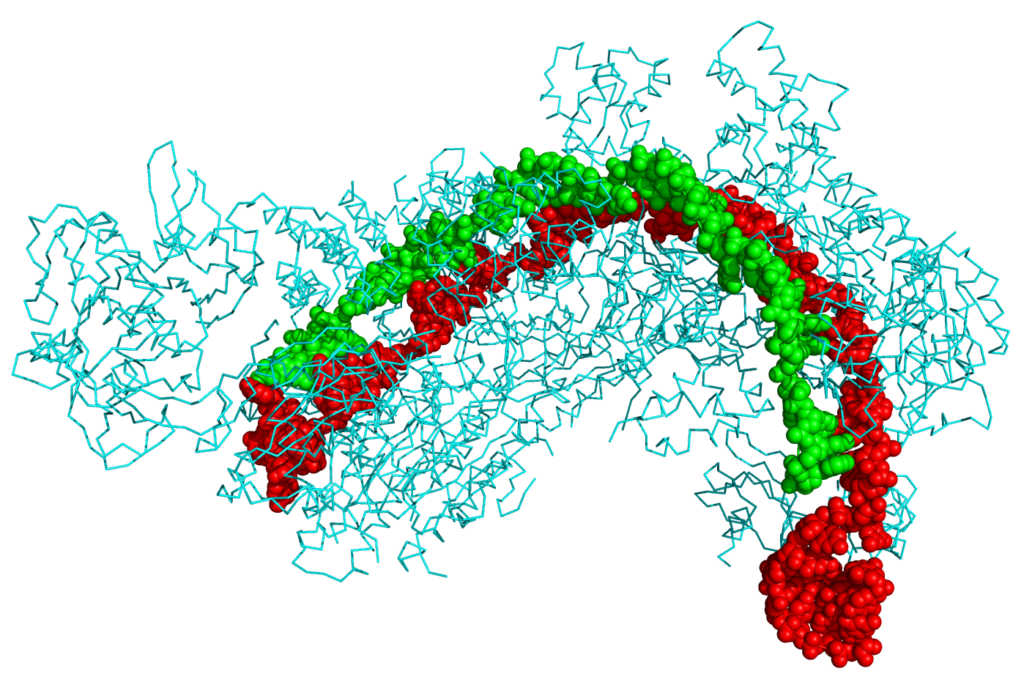
CRISPR gets described in headlines as everything from a cure for genetic disease to a tool for designer babies, and most of that coverage skips the part that actually matters: what the technology physically does inside a cell. Strip away the hype and CRISPR is a repurposed piece of bacterial immune machinery, borrowed from a system that’s billions of years old and turned into a set of molecular scissors precise enough to cut one exact sequence out of the three billion letters in a human genome.
Where It Actually Comes From
CRISPR wasn’t invented in a lab from scratch. Bacteria and archaea have used it for eons as a defense system against viruses. When a virus infects a bacterium and the bacterium survives, it keeps a small snippet of the virus’s DNA filed away in its own genome, in a region called CRISPR, as a kind of most-wanted record. If that same virus turns up again, the bacterium produces an RNA copy of that stored snippet and uses it to guide a protein, one version of which is called Cas9, to find and destroy the matching viral DNA on sight. Jennifer Doudna and Emmanuelle Charpentier figured out how to strip this system down to its essential parts and reprogram the guide sequence to target any DNA sequence a scientist chooses, not just viral DNA, work that won them the Nobel Prize in Chemistry in 2020.
The Two Pieces That Do the Work
A working CRISPR-Cas9 system needs two components. The first is a short guide RNA, typically around 20 bases long, built to match one specific sequence somewhere in the genome. Think of it as a search string. The second is the Cas9 protein itself, which acts as the actual cutting mechanism. Cas9 carries the guide RNA around the genome like a key looking for the one lock it fits, and it doesn’t act until it finds a perfect or near-perfect match, along with a short adjacent sequence called a PAM that has to be present for the cut to happen at all. That PAM requirement acts as a second checkpoint, reducing the odds that Cas9 cuts somewhere it shouldn’t.
Once Cas9 finds its target, it slices through both strands of the DNA double helix at that exact spot. That’s the entire “edit” at the mechanical level: a clean double-strand break at one chosen location in the genome.
Where the Actual Editing Happens
The cut itself doesn’t change anything. What changes the gene is what happens next, inside the cell’s own repair machinery, which treats any broken DNA strand as an emergency and rushes to fix it. Scientists exploit this repair process rather than doing the editing directly. One common repair pathway simply glues the cut ends back together, but it’s sloppy and often adds or deletes a few genetic letters in the process, which is frequently enough to disable the gene entirely. That alone is useful for research aiming to knock out a gene and see what it does. For more precise edits, researchers can supply a template strand of DNA alongside the cut, and a different, more careful repair pathway will sometimes use that template to patch the break, effectively writing in a specific new sequence exactly where the cut was made.
Why the Precision Matters
The reason CRISPR displaced older gene-editing tools so quickly comes down to that guide RNA. Earlier methods required engineering a custom protein for every single new target, which was slow and expensive. With CRISPR, changing the target is mostly a matter of changing a short RNA sequence, which is comparatively cheap and fast to synthesize. That’s what took gene editing from a specialized technique available to a handful of well-funded labs to something closer to a standard tool, currently in active clinical trials for conditions including sickle cell disease and certain inherited forms of blindness. The scissors haven’t changed much since Doudna and Charpentier’s original work. What’s changed is how many hands now know how to use them.
Sources and Credit
- “What is CRISPR-Cas9? How does CRISPR-Cas9 work?” Your Genome, Wellcome Genome Campus. yourgenome.org
- MedlinePlus Genetics, “What are genome editing and CRISPR-Cas9?” U.S. National Library of Medicine. medlineplus.gov
- Innovative Genomics Institute, “CRISPR Technology.” innovativegenomics.org
- “Advancing CRISPR genome editing into gene therapy clinical trials,” PMC/NIH. ncbi.nlm.nih.gov
SAYKAYZ is a publishing platform, not a publisher of record. Any dispute over authorship or attribution is between the parties involved; please see our Terms of Service.