
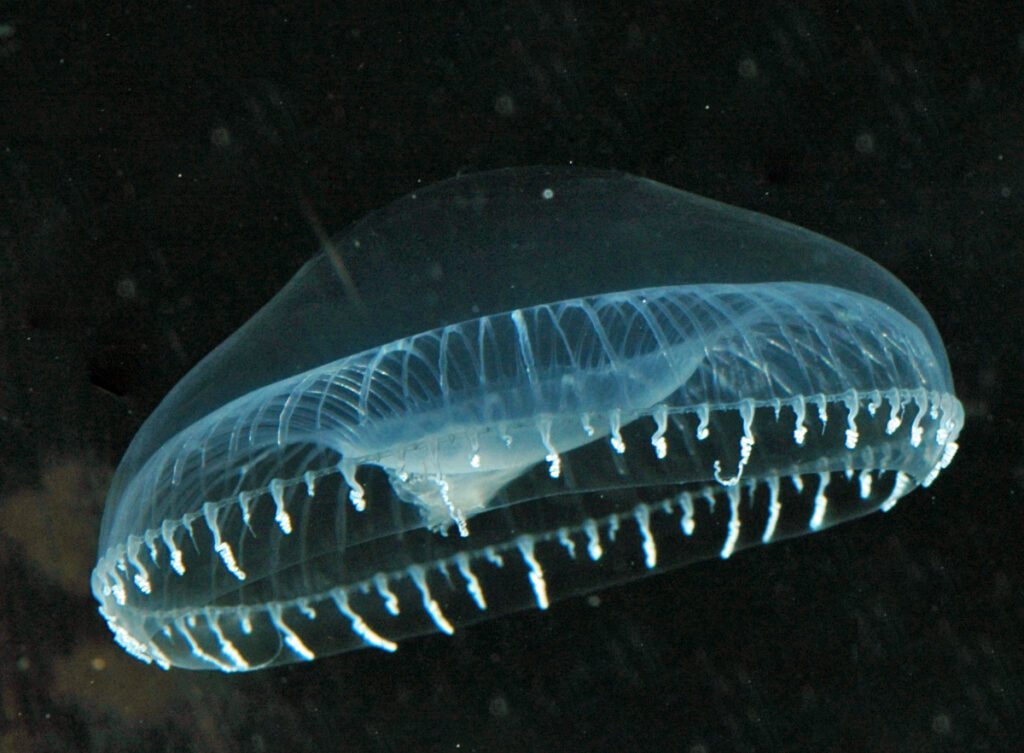
Drop below the reach of sunlight in the ocean, somewhere past 200 meters, and you’d expect total darkness. Instead, you’d find a world lit by its own residents. A seventeen-year survey by the Monterey Bay Aquarium Research Institute, tracking organisms from the surface down to 4,000 meters off the California coast, found that roughly three out of every four animals they observed could produce their own light. Bioluminescence isn’t a rare party trick in the deep sea. It’s closer to the default.
The Chemistry Behind the Glow
The light itself comes from a fairly simple reaction. A molecule called luciferin reacts with oxygen, catalyzed by an enzyme called luciferase, and that reaction releases energy as light instead of heat. Animals control when they light up by controlling how much oxygen reaches the cells where luciferin and luciferase are stored. It’s a strikingly efficient process. Almost all the energy from the reaction comes out as light, with very little wasted as heat, which is part of why the technology has been borrowed by biologists for lab use in things like gene expression tracking. The light produced is overwhelmingly blue-green, and that’s not a coincidence either. Blue and green wavelengths travel further through seawater than red or yellow light, so an animal signaling in blue-green is broadcasting as far as physically possible.
Four Different Reasons to Glow
Bioluminescence isn’t one strategy, it’s several, and different animals have converged on it for very different reasons.
The most famous is the lure. Anglerfish dangle a glowing appendage in front of their mouths, and smaller animals drawn to the light swim directly into range. It’s a trap built out of the same darkness that would otherwise hide the predator.
Just as common is defense. A sudden burst of light can startle a predator mid-attack, buying the prey animal a half-second to escape, the biological equivalent of a car alarm. Some species take it further and eject a cloud of glowing material, essentially a decoy explosion, while the real animal swims off in the confusion.
A subtler use is camouflage, and it’s arguably the most elegant. Animals living in the ocean’s twilight zone, including many lanternfish and squid, produce a faint glow from their undersides that matches the dim sunlight filtering down from above. Seen from below by a predator looking up, the animal’s silhouette disappears into the ambient light instead of standing out as a dark shape against a bright background. This is called counter-illumination, and it requires the animal to constantly adjust its glow to match the exact brightness of the water above it, which changes with depth, time of day, and cloud cover.
The fourth use is communication, which in the deep sea often means something closer to signaling than conversation. A flash pattern can mean “I’m here and interested” to a potential mate of the same species, using timing and rhythm the way fireflies do on land, except in three dimensions and total darkness.
An Ecosystem Running on Its Own Light
What’s easy to miss is how much this light shapes deep-sea ecology as a whole. In an environment with no sunlight, bioluminescence effectively is the visual world. Every relationship that depends on being seen, or not being seen, from finding a mate to avoiding becoming dinner, runs through it. It’s less like an unusual adaptation a handful of species picked up and more like an entire alternate sensory ecosystem that evolved independently, over and over, across totally unrelated branches of life, because in that particular kind of darkness, making your own light is one of the few strategies that actually works.
Sources and Credit
- Monterey Bay Aquarium Research Institute (MBARI), seventeen-year deep-sea bioluminescence survey. montereybayaquarium.org
- Woods Hole Oceanographic Institution, “How Does Bioluminescence Work?” whoi.edu
- National Geographic Education, “Bioluminescence.” education.nationalgeographic.org
SAYKAYZ is a publishing platform, not a publisher of record. Any dispute over authorship or attribution is between the parties involved; please see our Terms of Service.