
Almost 11 kilometers down, in the deepest known point on Earth, sits a place called the Challenger Deep. The pressure there is over 1,100 times what you feel standing at sea level, roughly the equivalent of an elephant standing on every square inch of your body. For most of human history, the working assumption was that nothing much could live down there. That assumption has been wrong for a while, and a 2025 expedition made it clear just how wrong.
Thousands of Species Nobody Had Named
Researchers working under the Mariana Trench Environment and Ecology Research program collected sediment samples from depths ranging from around 6,000 meters down to nearly 11,000 meters and ran them through advanced DNA sequencing. What they found was thousands of microbial species living in that sediment, and close to 90 percent of them had never been documented before. These aren’t organisms clinging to survival at the margins either. The bacteria living in the deepest layers showed enhanced antioxidant mechanisms and were accumulating specific protective compounds inside their cells, adaptations that show up again and again across completely different branches of life whenever pressure gets this extreme. That repetition is itself a finding: it suggests there’s a fairly limited number of biochemical tricks that work under crushing pressure, and evolution keeps landing on the same ones independently.
The Chemistry That Makes It Possible
The core problem for any living thing at hadal depths (the term for the deepest ocean zones, named after Hades) is that extreme pressure forces water molecules into places they don’t belong, including into the folded structure of proteins, which distorts them and stops them from working. Deep-sea organisms counter this with molecules called piezolytes. The best studied is trimethylamine N-oxide, or TMAO, which works almost like a bracket around a protein, creating a counter-pressure that keeps water out of the parts of the protein where it would cause damage.
TMAO concentration inside deep-sea fish tracks depth almost like a dial. In bony fish living at 7 to 8 kilometers down, in trenches like the Kermadec and the Mariana, TMAO levels inside cells can exceed 350 millimolar, several times what you’d find in a shallow-water fish. Crustaceans living at similar depths show the same pattern with a related set of compounds, including amino acids like valine and leucine and a sugar alcohol called scyllo-inositol, all of which seem to serve the same basic purpose of keeping proteins stable under pressure that would otherwise wreck them.
The Fish Built for the Deepest Water
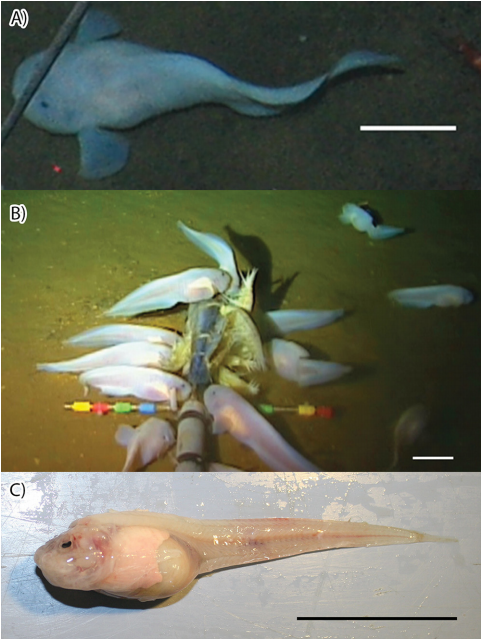
The hadal snailfish, Pseudoliparis swirei, is the fish most associated with the Mariana Trench and one of the deepest-living vertebrates ever documented. It doesn’t look like it’s built for extremity. Its skin and scales are thin and largely transparent, its bones are only partially hardened, and its skull isn’t fully closed the way most fish skulls are. Rather than resisting the pressure structurally, its body is built to accommodate it, staying soft and flexible rather than rigid. Genome sequencing of the species has turned up changes in genes related to bone development and cell membrane structure that likely explain some of this, and its liver shows unusually high levels of compounds involved in long-term energy storage, useful in an environment where meals are unpredictable and far apart.
An Environment We’re Still Mapping
What makes the Mariana Trench findings from the last few years notable isn’t just the individual adaptations, it’s the scale of what’s still unknown. A single expedition turning up thousands of new microbial species suggests the hadal zone, which makes up a meaningful fraction of the ocean floor globally, has barely been surveyed. Every trench explored in the last decade has turned up organisms and chemistry not seen anywhere else. The deepest parts of the ocean, it turns out, aren’t empty. They’re just unread.
Sources and Credit
- “Mariana Trench expedition discovers new lifeforms flourishing in deep-sea environment,” Phys.org, 2025. phys.org
- “Morphology and genome of a snailfish from the Mariana Trench provide insights into deep-sea adaptation,” Nature Ecology and Evolution. nature.com
- “Organic osmolytes of amphipods from littoral to hadal zones,” ScienceDirect. sciencedirect.com
- Trimethylamine N-oxide piezolyte research summary. Wikipedia
SAYKAYZ is a publishing platform, not a publisher of record. Any dispute over authorship or attribution is between the parties involved; please see our Terms of Service.