
Pluto Lost Its Planet Status, Then Turned Out to Be One of the Most Surprising Worlds We Know
In 2006, Pluto went from being the ninth planet to being a "dwarf planet", and plenty of people never forgave the astronomers responsible. Nine years later a spacecraft flew past it for the first time, and the world it revealed was far stranger and more active than anyone expected. The demotion and the discovery make an interesting pair: one is about how we label things, the other about what is actually out there.
Found by a Farm Boy With a Blink Comparator
Pluto was discovered in 1930 at Lowell Observatory in Flagstaff, Arizona, by Clyde Tombaugh, a young man from a Kansas farm who had been hired to search for a planet beyond Neptune. His method was painstaking. He photographed the same patch of sky on different nights, then flicked between the plates using a device called a blink comparator, looking for a single dot that had moved against thousands of fixed stars. In February 1930 he found one.
Pluto is small and far away. It is about 2,377 kilometres across, smaller than Earth's Moon, and orbits at an average distance of about 5.9 billion kilometres, around 39 times further from the Sun than Earth. One trip around the Sun takes 248 years. Its largest moon, Charon, is about half Pluto's size, which makes the pair the closest thing in the solar system to a double world.
Why It Was Reclassified
For decades Pluto looked like an oddity, a small icy planet at the edge of the system. Then, from the 1990s onwards, astronomers began finding many other icy bodies orbiting in the same region beyond Neptune, now called the Kuiper Belt. In 2005 a team led by Mike Brown found one, later named Eris, that was about as large as Pluto and more massive. If Pluto was a planet, so was Eris, and possibly dozens more.
In August 2006, the International Astronomical Union, the body that names things in astronomy, voted on a formal definition. To count as a planet, an object has to orbit the Sun, be massive enough for its own gravity to pull it into a round shape, and have "cleared the neighbourhood" around its orbit, meaning it is by far the dominant object in its path. Pluto meets the first two but not the third, because it shares its region with a great many other Kuiper Belt objects. It became a dwarf planet, alongside Eris and others.
The decision is still argued about. Some planetary scientists say a definition based on location rather than the nature of the object itself makes little sense, and would happily call any large round world a planet. For now, the 2006 definition stands.
The Flyby
NASA's New Horizons spacecraft launched in January 2006, months before the vote, and spent more than nine years crossing the solar system. On 14 July 2015 it passed about 12,500 kilometres above Pluto's surface, taking the first close-up pictures of the dwarf planet and its moons.
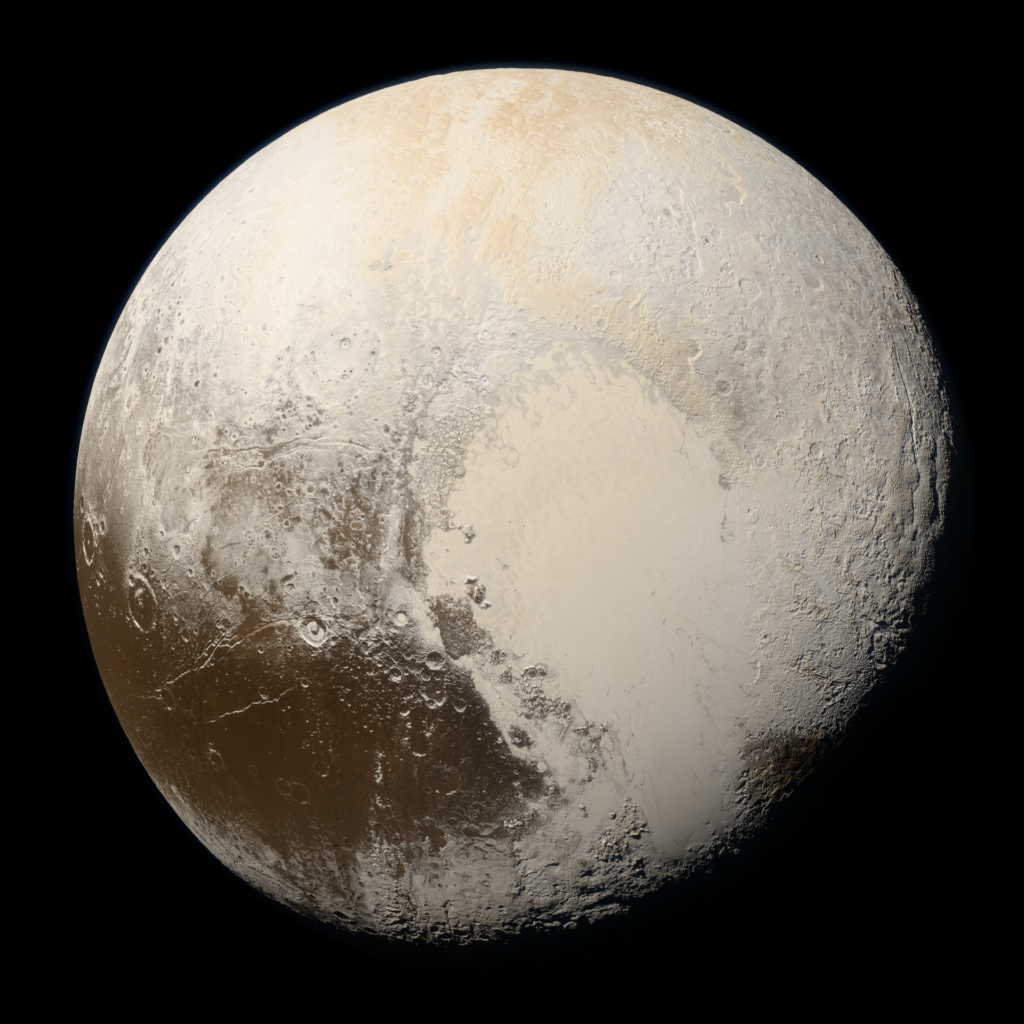
Many scientists had expected a dead, cratered ball of ice. Instead, Pluto turned out to have a huge, smooth, heart-shaped plain, now named Sputnik Planitia, made of frozen nitrogen. Its surface is broken into cells, a pattern thought to come from slow convection, with nitrogen ice warmed from below gradually welling up and sinking again. The almost complete lack of craters on the plain means its surface is geologically young, renewed within roughly the last ten million years.
Around it stand mountains several kilometres high made of blocks of water ice, which at Pluto's temperatures behaves like rock. Above it all is a thin atmosphere, mostly nitrogen with traces of methane. And the evidence now points to something nobody expected that far from the Sun: a vast ocean of liquid water, probably hidden beneath Pluto's icy shell.
A Planet or Not, It Is Alive
The irony is hard to miss. In the same year Pluto was demoted, the mission that would show it to be one of the most geologically active small worlds in the solar system was already on its way. Whatever we choose to call it, Pluto turned out to be a place where ice flows and the surface is still being remade, nearly six billion kilometres from the Sun.
Sources and Credit
- "Pluto: Facts," NASA Science. science.nasa.gov
- "Aug. 24, 2006: Pluto is demoted," Astronomy magazine. astronomy.com
- Trilling, D.E. "The Surface Age of Sputnik Planum, Pluto, Must Be Less than 10 Million Years." PLOS ONE (2016). ncbi.nlm.nih.gov
- "Five Years after New Horizons' Historic Flyby, Here Are 10 Cool Things We Learned About Pluto," NASA. nasa.gov
- "Pluto's Icy Plains Captured in Highest-Resolution Views from New Horizons," NASA Jet Propulsion Laboratory. jpl.nasa.gov
- Featured image: Pluto in true colour, with its pale heart-shaped plain, by NASA, Johns Hopkins University Applied Physics Laboratory, Southwest Research Institute and Alex Parker, via Wikimedia Commons, in the public domain. commons.wikimedia.org
SAYKAYZ is a publishing platform, not a publisher of record. Any dispute over authorship or attribution is between the parties involved; please see our Terms of Service.