
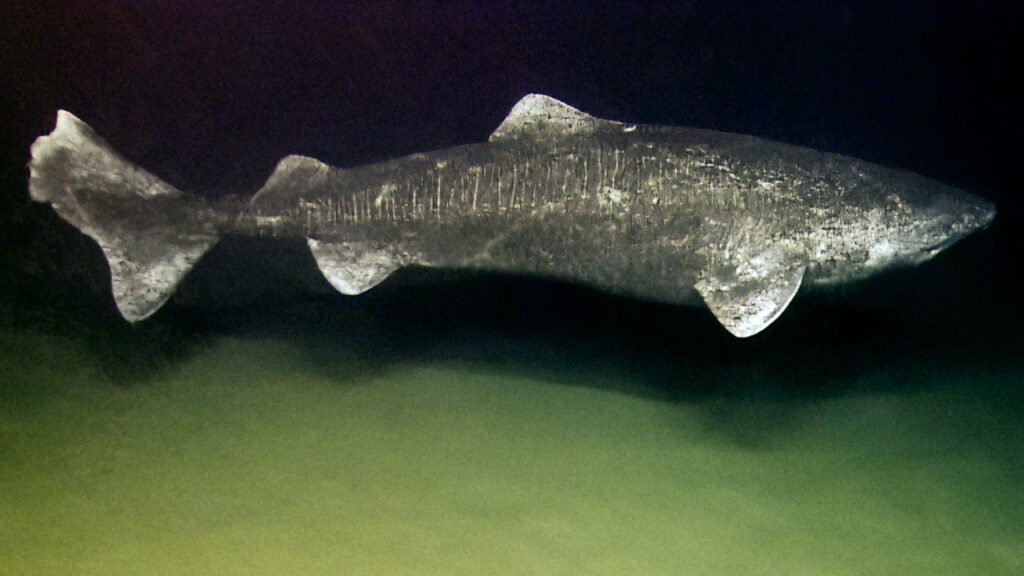
Somewhere in the cold, dark water of the North Atlantic, there may be sharks swimming today that were already alive when Isaac Newton was born in 1643. The Greenland shark is the longest-lived vertebrate known to science, and the way researchers worked out its age is almost as clever as the number is surprising.
A Slow Shark in Cold Water
Greenland sharks live in the Arctic and North Atlantic, often in water close to freezing and sometimes more than a kilometre deep. They are large, commonly four to five metres long, and move very slowly. When researchers led by Yuuki Watanabe of Japan's National Institute of Polar Research attached data loggers to six free-swimming sharks, they found top speeds of only about 2.7 kilometres an hour. Relative to its size, it is among the slowest fish ever measured, probably in part because of the cold water it lives in.
Yet their stomachs have held fresh seal, which suggests they catch some of it rather than scavenging. Watanabe's team suggested the sharks may creep up on seals while they sleep in the water, though nobody has filmed it.
How Do You Age a Shark?
Most fish can be aged by counting growth rings in hard parts of the body, like the rings of a tree. Many sharks have rings in their vertebrae. Greenland sharks have soft, poorly calcified skeletons and no reliable rings, so for a long time their age was a mystery.
In 2016, a team led by Julius Nielsen of the University of Copenhagen found a solution in the eye. The central part of the lens of a vertebrate eye is made of proteins laid down before birth that are never replaced. Measure when those proteins formed, and you know when the animal was born.
The team used radiocarbon dating on the eye lenses of 28 female sharks caught as accidental bycatch. They had a useful extra clue. Nuclear bomb tests in the 1950s and early 1960s added a sharp spike of radiocarbon to the atmosphere and oceans, a marker known as the bomb pulse. Only the smallest sharks in the study, under about 2.2 metres long, carried that signal, so they were born after the early 1960s. Every larger shark had to be older than that.
Combining the radiocarbon results with the sharks' sizes, the team estimated a lifespan of at least 272 years. The largest shark, just over five metres long, was estimated to be 392 years old, give or take 120 years. Even at the low end of that range it would be more than 270, older than any other vertebrate measured.
Growing Up Takes a Century and a Half
The same study suggested Greenland sharks grow only about a centimetre a year, and that females do not reach sexual maturity until they are around 150 years old. That has serious consequences. A species that takes a century and a half to start breeding recovers very slowly from losses, so even modest numbers of sharks caught by accident in fishing nets can matter.
Eyes That Last for Centuries
Greenland sharks often have a small parasitic crustacean hanging from the eye, and their eyes can look cloudy, which led to a widespread belief that they are mostly blind. A study published in Nature Communications in 2025, led by Dorota Skowronska-Krawczyk at the University of California, Irvine, examined their eyes in detail and found healthy retinas, with light-detecting proteins tuned to the dim blue light of the deep. The researchers found no sign of the age-related damage seen in other animals and suggested that strong DNA repair may help keep the shark's eyes working for centuries.
What Scientists Hope to Learn
How an animal lives for hundreds of years without its body falling apart is a question with obvious interest for human ageing. Cold water and a slow metabolism are probably part of the answer, but researchers are now looking at the shark's genes and tissues for the mechanisms that protect them. For now, the Greenland shark remains one of the strangest record holders in the animal kingdom: a slow, quiet giant that may outlive every person who ever studies it.
Sources and Credit
- "Greenland Sharks are Longest-Lived Vertebrates on Earth, Marine Biologists Say," Sci.News, on Nielsen et al. in Science (2016). sci.news
- "Presenting the World's Slowest Shark," Live Science, on Watanabe et al. (2012). livescience.com
- "Dissected Greenland shark eyeballs could help humans see forever," Popular Science, on Fogg et al. in Nature Communications (2025). popsci.com
- Featured image: A Greenland shark swimming above the sea floor, by NOAA Okeanos Explorer Program, via Wikimedia Commons, in the public domain. commons.wikimedia.org
SAYKAYZ is a publishing platform, not a publisher of record. Any dispute over authorship or attribution is between the parties involved; please see our Terms of Service.