
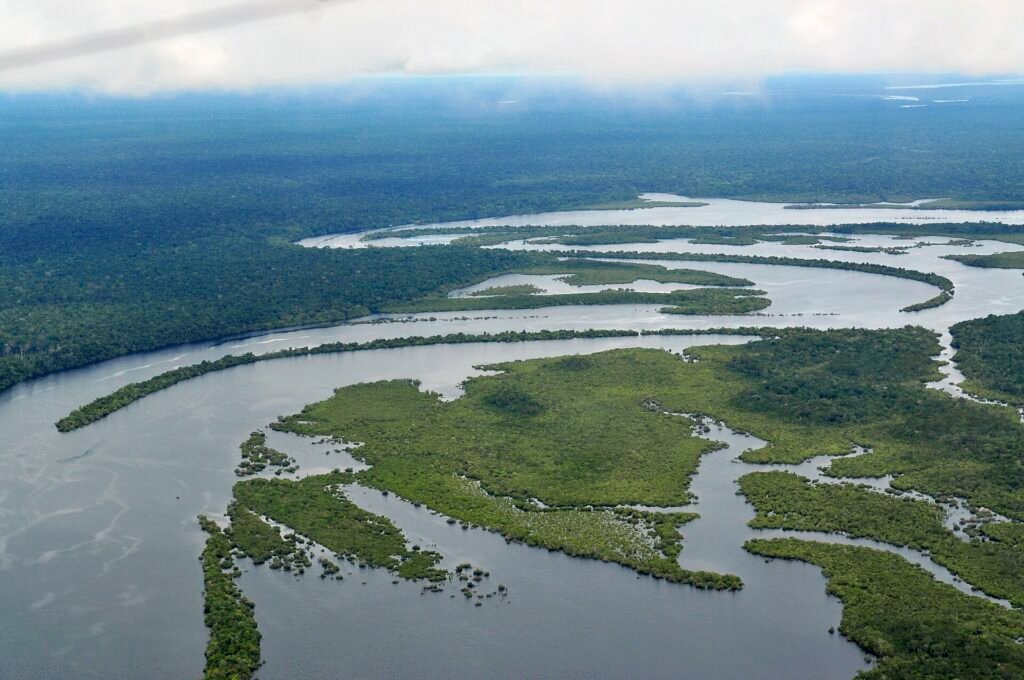
It is easy to think of a rainforest as something that exists because it rains a lot. In the Amazon, the relationship also runs the other way. The forest helps make the rain that keeps it alive, and even helps decide when the rainy season begins. That two-way relationship is also why scientists worry that cutting down enough of it could make the rest start to fail.
Trees as Water Pumps
A tree constantly pulls water up from the soil through its roots and lets most of it escape as vapour through tiny pores in its leaves. This is called transpiration. One large tree can release hundreds of litres of water into the air on a hot day, and the Amazon holds an almost unimaginable number of trees.
Spread across the roughly 5.5 million square kilometres of the rainforest, that adds up to an enormous volume of water lifted from the land into the air every day. Much of that vapour rises, cools, condenses into clouds and falls again as rain further along, where it is picked up by more trees and released again.
Because the prevailing winds blow across the basin from the Atlantic towards the Andes, this recycling carries moisture deep inland, far beyond where ocean air alone would reach. Studies suggest that up to half of the rain that falls on the Amazon is water the forest itself has already recycled at least once. The great currents of moisture that flow through the sky above South America have been nicknamed "flying rivers", and they carry water on to farmland far to the south, in southern Brazil and beyond.
The Forest Starts the Rainy Season
In 2017, a team led by Jonathon Wright, then at Tsinghua University, published a study in the Proceedings of the National Academy of Sciences that showed just how active the forest is in this process.
In the southern Amazon, the rainy season was known to begin before the winds bringing moist air from the ocean arrive. Something else had to be supplying the moisture. Using NASA's Aura satellite, the team measured a subtle chemical signature in the water vapour above the forest. Water evaporated from the ocean and water released by plants carry slightly different amounts of a heavy form of hydrogen called deuterium. The vapour above the forest at the end of the dry season had the plant signature.
The picture they put together is that the trees, by releasing water late in the dry season, moisten the lower atmosphere and set off small, shallow clouds. Those clouds build up moisture and instability higher in the air until the large storms of the wet season can take over. In effect, the forest primes the atmosphere and starts its own rainy season.
Why Deforestation Matters Twice
That same study pointed to a worrying feedback. NASA noted that the wet season in the southern Amazon now begins as much as a month later than it did in the 1970s. Fewer trees means less water released into the air, which can mean a longer dry season, which stresses the remaining forest further.
In 2018, the ecologist Thomas Lovejoy and the climate scientist Carlos Nobre wrote in Science Advances that the combined effects of deforestation, climate change and fire could push large parts of the Amazon past a tipping point at around 20 to 25 percent forest loss. Beyond that point, they argued, much of the eastern, southern and central Amazon could gradually shift from rainforest to a drier, more open landscape that cannot recycle rain the way the forest does. When they wrote, deforestation had already reached roughly 20 percent.
A Forest That Shapes a Continent
The Amazon is often described as the lungs of the planet, but in some ways it is more like a heart, pumping water through the sky to keep itself and the land around it alive. Cutting it down costs more than the trees and animals inside it. It also costs some of the rain that falls far beyond its edges.
Sources and Credit
- "The Amazon Makes Its Own Wet Season," NASA Earth Observatory, on Wright et al. in PNAS (2017). science.nasa.gov
- "Amazon deforestation is close to tipping point," Phys.org, on Lovejoy and Nobre in Science Advances (2018). phys.org
- Featured image: Aerial view of the Amazon rainforest with a winding river, by CIAT, via Wikimedia Commons, licensed CC BY-SA 2.0. commons.wikimedia.org
SAYKAYZ is a publishing platform, not a publisher of record. Any dispute over authorship or attribution is between the parties involved; please see our Terms of Service.