
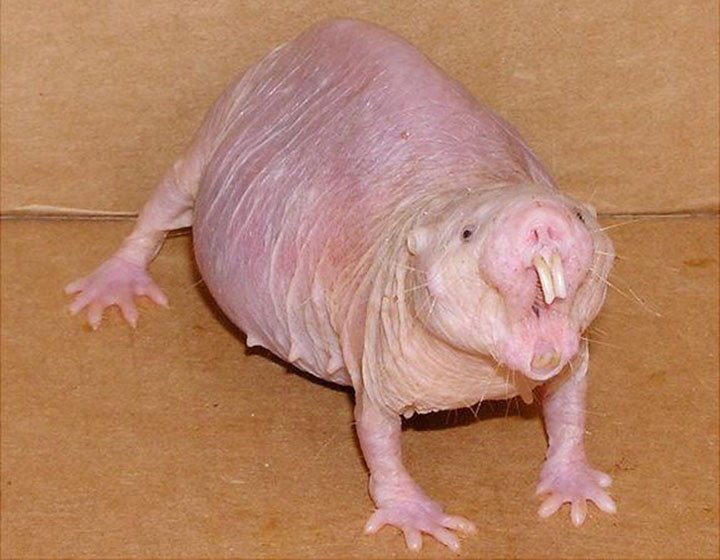
Naked mole-rats are not much to look at. They are wrinkled, pink, almost hairless, with buck teeth that stick out in front of closed lips so they can dig without swallowing soil. They live in large underground colonies in the dry grasslands of East Africa, run by a single breeding queen, a social setup more like an ant nest than a typical mammal family. And they have become one of the most closely studied animals in biology, because they seem to ignore several rules that every other mammal follows.
A Mouse-Sized Animal That Lives 30 Years
Small mammals usually live short lives. A house mouse is old at two or three. Naked mole-rats are about the same size, yet in captivity they can live for more than 30 years, making them the longest-lived rodents known.
Living long is one thing. Not aging is another. For almost every animal studied, the risk of dying climbs steadily with age once adulthood is reached. This pattern is so consistent that it has a name, the Gompertz law, first described in the 1820s. In 2018, researchers Graham Ruby, Megan Smith and Rochelle Buffenstein analysed records of more than 3,000 naked mole-rats kept over several decades. They found that the animals' risk of dying did not rise with age at all, even in individuals 25 times older than the age at which they could first breed. Old mole-rats were no more likely to die in a given year than young ones.
The animals do still change as they get older, and they do eventually die. But by the measure that defines aging in population terms, naked mole-rats barely seem to age.
Almost No Cancer
Researchers who kept large colonies for decades also noticed that the animals hardly ever got cancer. A 2013 study by Vera Gorbunova, Andrei Seluanov and colleagues at the University of Rochester offered one explanation. Naked mole-rat tissues are packed with a very large form of hyaluronan, a sugar molecule that sits between cells. Their version is more than five times larger than the human one. When the researchers removed it, mole-rat cells in the lab became prone to forming tumours.
The likely reason they evolved it has nothing to do with cancer. A thick, gooey substance between cells keeps skin elastic, which helps an animal squeeze through narrow tunnels. Cancer protection appears to have come along as a side effect.
The phrase "cancer-proof" gets used a lot, and it is not quite right. In 2016, vets reported the first two confirmed cases of cancer in naked mole-rats, both in older animals living in zoos in Chicago and Washington. Cancer is possible. It is just very rare.
Eighteen Minutes Without Oxygen
Life in a crowded burrow means the air can get very stale. Hundreds of animals breathing in a sealed tunnel system push oxygen down and carbon dioxide up to levels that would harm people. Naked mole-rats handle this better than any other mammal tested.
In a 2017 study in Science, Thomas Park of the University of Illinois at Chicago, with colleagues in Berlin and elsewhere, put naked mole-rats in air with no oxygen at all. Mice lost consciousness and could not be revived, even when air was restored within a minute. The mole-rats passed out, slowed their heart rate dramatically, and survived for up to 18 minutes. When normal air came back, they woke up with no obvious harm.
Their trick was a change of fuel. Mammal brains normally run on glucose, which needs oxygen to be fully used. Deprived of oxygen, naked mole-rats flooded their blood with fructose, a sugar more associated with fruit and plants, and pumped it into their brains and hearts. Their cells could burn fructose in a way that does not need oxygen. The genes that make this possible exist in other mammals too, including us, but are mostly switched off in those organs.
What People Hope to Learn
None of this means people will live like mole-rats. But each of these traits points at something worth studying, from how tissues resist turning cancerous to how a heart or brain might survive a lack of oxygen during a heart attack or stroke. A strange, wrinkled rodent from under the East African soil has become a living reminder that the limits we assume for mammal bodies are not fixed.
Sources and Credit
- Ruby, J.G., Smith, M. and Buffenstein, R. "Naked mole-rat mortality rates defy Gompertzian laws by not increasing with age." eLife (2018). elifesciences.org
- "Why Naked Mole Rats Don't Get Cancer," National Geographic, on Tian et al. in Nature (2013). nationalgeographic.com
- "Rare cancer cells discovered in naked mole rats," Smithsonian Insider, on Delaney et al. in Veterinary Pathology (2016). insider.si.edu
- "This Surprising Rodent Can Survive 18 Minutes Without Oxygen," National Geographic, on Park et al. in Science (2017). nationalgeographic.com
- Featured image: A naked mole-rat with its front teeth visible, by Kein keen, via Wikimedia Commons, licensed CC BY-SA 4.0. commons.wikimedia.org
SAYKAYZ is a publishing platform, not a publisher of record. Any dispute over authorship or attribution is between the parties involved; please see our Terms of Service.