
The Atlantic’s Conveyor Belt: How the AMOC Works and Why Scientists Watch It
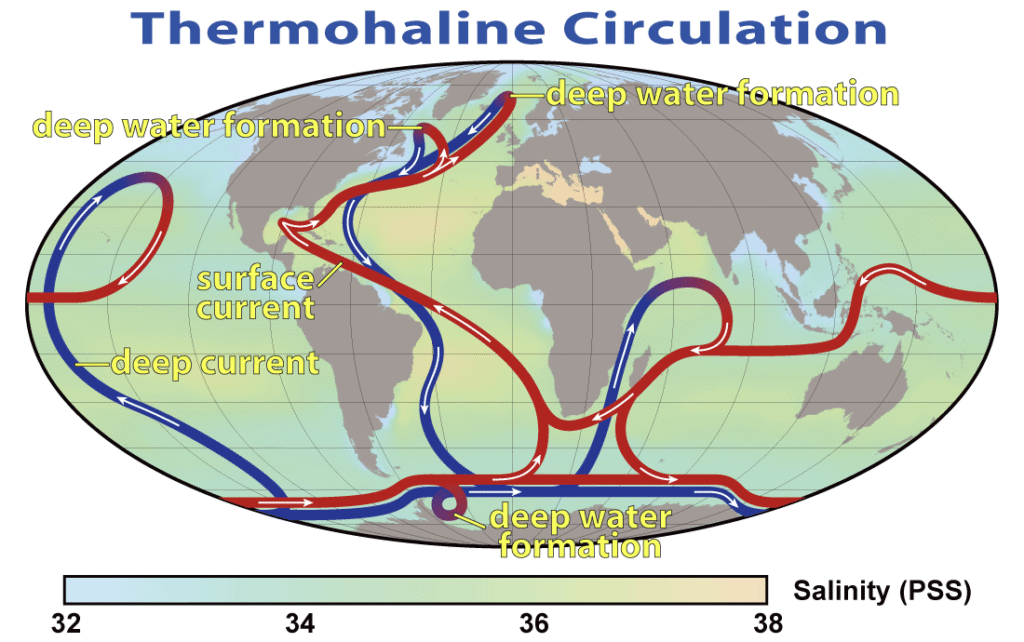
London sits further north than Calgary, yet its winters are far milder. Part of the reason is a vast system of ocean currents that carries warm water from the tropics up into the North Atlantic. Its full name is the Atlantic Meridional Overturning Circulation, usually shortened to AMOC. It is one of the most important parts of the climate system, and one of the most closely watched, because there are signs it may be slowing.
How the Conveyor Moves
The AMOC is driven by differences in how dense seawater is, which depends on temperature and salt. It works in a loop.
- Warm, salty water flows north from the tropics near the surface, with the Gulf Stream as part of the system.
- As it travels north it gives off heat to the air above it, which is part of what warms north-western Europe. Some water also evaporates along the way, leaving the rest saltier.
- In the far North Atlantic, near Greenland and in the Labrador and Nordic Seas, the water is now cold and salty, which makes it dense enough to sink kilometres down.
- That deep, cold water then creeps slowly south along the ocean floor, eventually spreading into other ocean basins, while new warm water flows north to replace it.
The word "overturning" describes exactly this: warm water at the top heading one way, cold water at the bottom heading the other.
Measuring a Current Across an Entire Ocean
Measuring something this big is hard. Since 2004, a British and American project called RAPID has kept a line of instruments moored across the Atlantic at a latitude of 26.5 degrees north, roughly from Florida to the coast of North Africa. Moorings along the line record temperature, salt and pressure from the surface to the seabed, a cable across the Florida Strait measures the Gulf Stream, and satellites measure the effect of the wind.
Ocean scientists measure currents like this in Sverdrups, where one Sverdrup is a million cubic metres of water per second. Over the first years of RAPID measurements, from 2004 to 2012, the AMOC averaged about 17 Sverdrups.
| What | Approximate figure |
|---|---|
| Average AMOC flow at 26.5°N, 2004 to 2012 | About 17 million cubic metres per second |
| Heat carried north in that period | About 1.25 petawatts |
| RAPID array in continuous operation since | 2004 |
Why a Slowdown Is Possible
Global warming affects the AMOC from both directions. Warmer surface water is lighter, and so is fresher water, and the North Atlantic is getting both warmer and fresher, partly from melting ice on Greenland. Lighter water at the top sinks less readily, which can weaken the part of the loop that drives everything else.
The Intergovernmental Panel on Climate Change, in its Sixth Assessment Report, concluded that the AMOC is very likely to weaken over the 21st century. On a complete shutdown, it said there was medium confidence that there will not be an abrupt collapse before 2100.
Not everyone agrees with that timeline. In 2023, the Danish researchers Peter and Susanne Ditlevsen published a statistical analysis in Nature Communications using long records of sea surface temperatures as an indicator of the AMOC's strength. They estimated a collapse could happen between 2025 and 2095, most likely around the middle of the century if emissions continue on their current path. Other scientists have questioned the assumptions behind that estimate, and the debate is ongoing.
What a Collapse Would Mean
A full collapse would not freeze Europe overnight in the way disaster films suggest, but its effects would be serious. Models suggest much colder winters in north-western Europe, shifts in tropical rainfall patterns that billions of people depend on, and faster sea level rise along the east coast of North America.
That is why instruments have been sitting on the Atlantic seabed for two decades, quietly measuring a current most people never think about. For now, it keeps turning. The question is how much warming it can absorb before it changes.
Sources and Credit
- "What is the Atlantic Meridional Overturning Circulation?" Met Office. weather.metoffice.gov.uk
- RAPID-AMOC programme history, National Oceanography Centre. rapid.ac.uk
- "Measuring the Atlantic Meridional Overturning Circulation at 26°N," University of Miami (figures for 2004 to 2012). scholarship.miami.edu
- Ditlevsen, P. and Ditlevsen, S. "Warning of a forthcoming collapse of the Atlantic meridional overturning circulation." Nature Communications (2023). doi.org
- Featured image: World map of the global ocean conveyor, with warm surface currents in red and cold deep currents in blue, by Robert Simmon, NASA (minor changes by Robert A. Rohde), via Wikimedia Commons, in the public domain. commons.wikimedia.org
SAYKAYZ is a publishing platform, not a publisher of record. Any dispute over authorship or attribution is between the parties involved; please see our Terms of Service.