
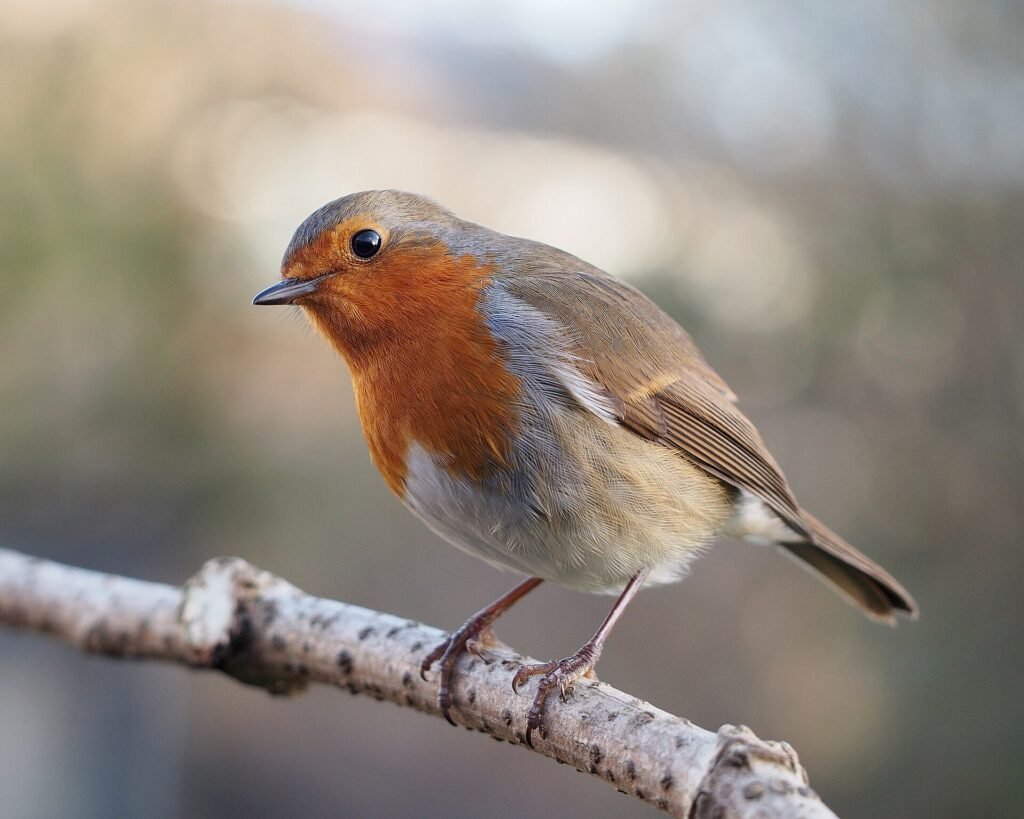
Every autumn, European robins that breed in Scandinavia leave for southern Europe and North Africa. Many of them fly at night, alone, over land and sea they may never have crossed before, and still end up in the right place. They use the stars and the setting sun, but they also use something people cannot sense at all: the Earth's magnetic field. For decades nobody could say how. The answer that is now taking shape involves a protein in the eye and a piece of quantum physics.
A Compass That Reads the Tilt
The first solid proof came from Germany. In experiments published in the late 1960s and early 1970s, Wolfgang Wiltschko put migratory robins in funnel-shaped cages during the migration season and changed the magnetic field around them with electric coils. The birds hopped in the direction they wanted to fly, and when the field was turned, their preferred direction turned with it.
The surprising detail was how they read the field. A normal compass needle points to magnetic north. The robins did not seem to care which way the field's lines pointed. What they used was the angle at which the field lines dip into the ground, steep near the poles and flat near the equator. Birds use that tilt to tell "towards the pole" from "towards the equator". When the researchers made the field lines horizontal, as they are at the magnetic equator, the birds became disoriented.
That kind of compass rules out a simple magnet inside the bird, and it points towards a chemical one.
Quantum Chemistry in the Eye
The leading explanation is called the radical pair mechanism. When certain molecules absorb light, an electron can jump from one part of a molecule to another, leaving two unpaired electrons, a so-called radical pair. Electrons have a quantum property called spin, and the two spins can be in step or out of step. A magnetic field, even one as weak as the Earth's, can nudge how often the pair flips between those states. That in turn changes what chemical products the reaction ends up making. In principle, an animal could read the direction of a magnetic field from the chemistry of molecules in its eye.
The best candidate molecule is a protein called cryptochrome, found in the retina. In 2021, a team led by Henrik Mouritsen at the University of Oldenburg and Peter Hore and Christiane Timmel at Oxford published a study in Nature on cryptochrome 4 taken from European robins. They produced the protein in bacteria, then tested it with magnetic resonance and laser techniques. When hit with blue light, the robin's cryptochrome 4 formed radical pairs whose chemistry changed in response to magnetic fields. It was more sensitive than the same protein from chickens and pigeons, birds that do not migrate at night.
The researchers were careful about what this does not yet show. Proving that the protein works this way inside a living robin's eye is still beyond current technology. But it is the strongest evidence yet that birds may sense the planet's field through quantum effects in a protein.
A Compass You Can Jam
If the sense really relies on such delicate chemistry, it should be easy to disrupt, and it is. In 2014, the Oldenburg team noticed that robins kept in wooden huts on the university campus could not orient with their magnetic compass. When they lined the huts with grounded aluminium screening, blocking the background radio noise from the city, the birds oriented normally again. Remove the grounding, and the birds were lost.
The interference came from the AM radio band and electrical equipment, at levels far below what is considered safe for people, hundreds to a thousand times under international exposure limits. Out in the open countryside, away from the noise, the birds' compass worked fine. The finding does not mean migrating birds are getting lost over cities, since they have other cues to fall back on. It does show how faint the signal they are reading must be.
A Sense We Can Only Imagine
Picture it: a bird's eye running quantum chemistry on incoming light to work out which way is south. It may even be that robins see the magnetic field as a faint pattern laid over their vision, though nobody can ask them. What we know is that a robin weighing around 20 grams can carry a compass inside its eye, and that it has been finding its way with it for far longer than people have been building compasses of their own.
Sources and Credit
- Wiltschko, W. "The influence of magnetic total intensity and inclination on directions preferred by migrating European robins." Animal Orientation and Navigation, NASA (1972). ntrs.nasa.gov
- "International collaboration sheds light on the mechanism of magnetic sensing in birds," University of Oxford, on Xu et al. in Nature (2021). chem.ox.ac.uk
- "Man-Made Electromagnetic Noise Disrupts a Bird's Compass," National Geographic, on Engels et al. in Nature (2014). nationalgeographic.com
- Featured image: A European robin perched on a branch, by Francis C. Franklin, via Wikimedia Commons, licensed CC BY-SA 3.0. commons.wikimedia.org
SAYKAYZ is a publishing platform, not a publisher of record. Any dispute over authorship or attribution is between the parties involved; please see our Terms of Service.