
How a Lithium-Ion Battery Stores Energy, and Why It Slowly Wears Out
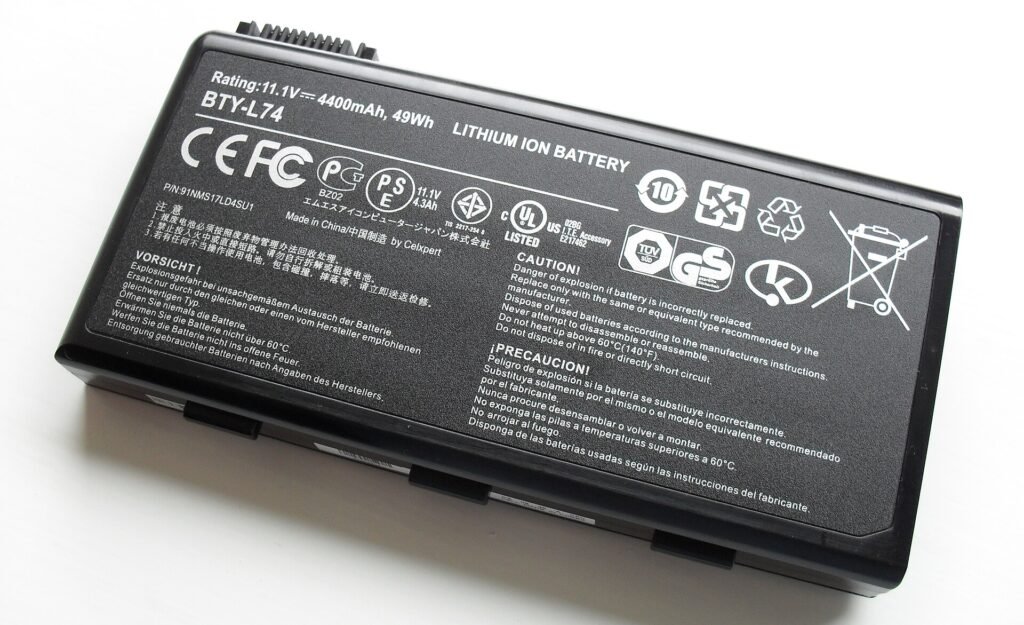
Your phone, your laptop and most electric cars run on the same basic idea: lithium atoms shuffling back and forth between two materials. The technology is so ordinary now that it is easy to forget it won a Nobel Prize, or that the battery in your pocket loses a little of its capacity every time you use it. Both facts come from the same chemistry.
Ions Moving Between Two Layers
A lithium-ion battery has two electrodes. One, the anode, is usually made of graphite, the same layered form of carbon found in pencils. The other, the cathode, is a metal oxide, often containing cobalt, nickel or manganese. Between them is a liquid electrolyte that lets lithium ions pass, and a thin plastic separator that stops the two electrodes from touching.
Both electrodes are built like a stack of thin sheets with gaps between them. Lithium ions can slip into those gaps and back out again without breaking the structure. Chemists call this intercalation. When you charge the battery, a charger pushes lithium ions out of the cathode, through the electrolyte, and into the gaps between the graphite layers of the anode. The electrons that belong with them are pushed through the outside circuit to the same place.
When you use the battery, the process runs in reverse. The lithium ions drift back through the electrolyte to the cathode, and the electrons travel back through your phone or car to rejoin them, powering it on the way. Nothing is burned and nothing is used up. The same lithium moves back and forth, hundreds or thousands of times.
Three Steps to a Nobel Prize
The 2019 Nobel Prize in Chemistry went to three people who each solved part of the puzzle.
Stanley Whittingham, working in the 1970s, built the first working lithium battery using a cathode of titanium disulfide, a material with spaces that lithium ions could slot into. It worked, but its anode was pure lithium metal, which is highly reactive and made the battery prone to catching fire.
John Goodenough reasoned that a metal oxide would give a higher voltage. In 1980 he showed that cobalt oxide holding lithium ions could produce as much as four volts, a big step up and the basis of most cathodes since.
Akira Yoshino then replaced the dangerous lithium metal anode with a carbon material that could hold lithium ions in its layers. In 1985 he built the first commercially workable lithium-ion battery. It was light, rechargeable many times, and much safer. Lithium-ion batteries went on sale in 1991.
Why Batteries Lose Capacity
If the lithium simply moves back and forth, why does a two-year-old phone die by mid-afternoon? Because the shuffling is not perfectly clean.
One of the main culprits forms on the very first charge. The electrolyte reacts with the surface of the graphite anode and leaves behind a thin crust called the solid electrolyte interphase, or SEI. A thin SEI is actually useful, because it protects the anode from further reactions while still letting lithium ions through. But it never stops growing entirely. Each time it grows, it traps a little lithium that can no longer carry charge, and it makes the path for the remaining ions harder, raising the battery's internal resistance.
Two things speed this up a lot: heat, and keeping the battery at a very high charge for long periods. A phone left on a hot dashboard at 100 percent is close to the worst case.
A second problem appears when charging is too fast or too cold. If lithium ions arrive at the anode faster than they can slip into the graphite, some of them pile up on the surface as metallic lithium instead. This lithium plating removes more lithium from use and, in bad cases, can grow into needle-like structures that are a safety risk.
Making Yours Last Longer
The chemistry suggests some practical habits. Avoid leaving devices in hot places, especially while charging. Avoid keeping them at 100 percent for days on end, which is why many phones and laptops now offer an option to stop charging at around 80 percent. Occasional fast charging is fine. Just know that heat and speed both cost the battery a little life.
The lithium in your battery is still there after a few years. What has changed is how much of it can still make the trip. Each charge and discharge loses a few more, and good battery design is mostly about losing them as slowly as possible.
Sources and Credit
- "The Nobel Prize in Chemistry 2019," press release, Royal Swedish Academy of Sciences. nobelprize.org
- "Lithium-ion batteries," Ossila (how intercalation, the electrodes and charging work). ossila.com
- "A Single Particle Model with Electrolyte and Side Reactions for degradation of lithium-ion batteries," arXiv (models SEI growth and lithium plating as causes of capacity loss). arxiv.org
- "Lithium plating," Ionworks (2025). ionworks.com
- Featured image: A lithium-ion laptop battery pack, by Kristoferb, via Wikimedia Commons, licensed CC BY-SA 3.0. commons.wikimedia.org
SAYKAYZ is a publishing platform, not a publisher of record. Any dispute over authorship or attribution is between the parties involved; please see our Terms of Service.