
Until 1977, biology textbooks had a simple rule for life on Earth. Almost every food chain started with sunlight. Plants and algae turn light into sugar, animals eat the plants, other animals eat those animals. In the deep ocean, where no light reaches, life was thought to survive on scraps, a slow drizzle of dead material sinking from the sunlit surface. Then a small submarine went looking for hot water near the Galápagos Islands and found something nobody had predicted.
Searching for Warm Water
In February 1977, a team of geologists from Woods Hole Oceanographic Institution and other institutions went to the Galápagos Rift, a crack in the seafloor where two tectonic plates pull apart. They were looking for hydrothermal vents, places where seawater seeps down into the hot rock, heats up, and gushes back out loaded with minerals. The geology predicted vents should exist. Nobody had seen one.
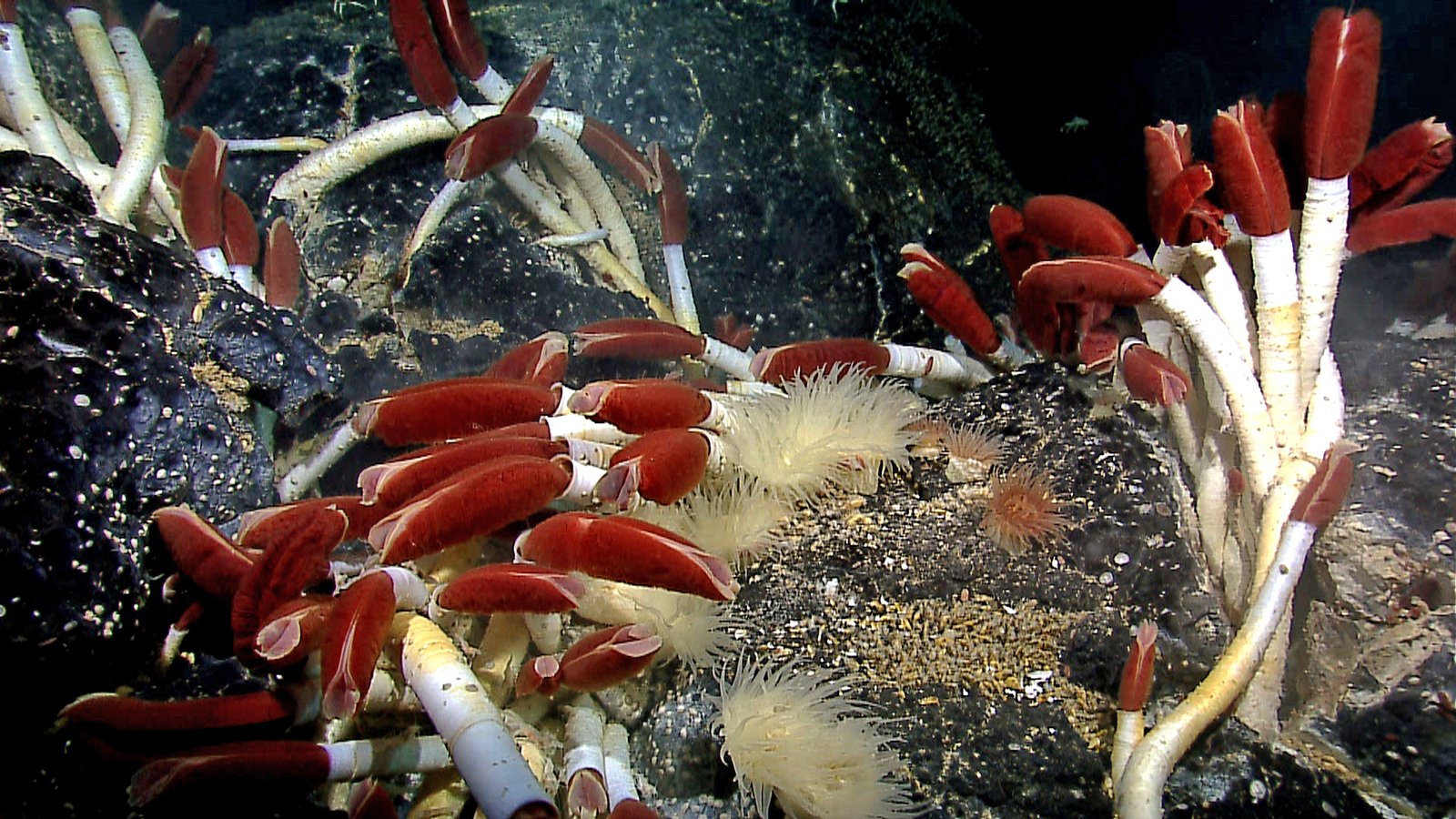
They found the warm water at a depth of about 2,500 metres, using the research submersible Alvin. They also found life. Around the vents were dense communities of animals, giant clams a foot long, mussels, pale crabs and, strangest of all, tube worms as tall as a person, with bright red plumes sticking out of white tubes. There were no biologists on that first expedition, because nobody had expected anything to study.
Food From Chemicals
A community that dense needs a big, steady food supply, far more than falling scraps could provide. The answer turned out to be chemistry. Vent water is rich in hydrogen sulfide, the gas that gives rotten eggs their smell, and toxic to most animals. Certain bacteria can use the energy stored in hydrogen sulfide to turn carbon dioxide into sugars, doing with chemical energy what plants do with sunlight. This process is called chemosynthesis.
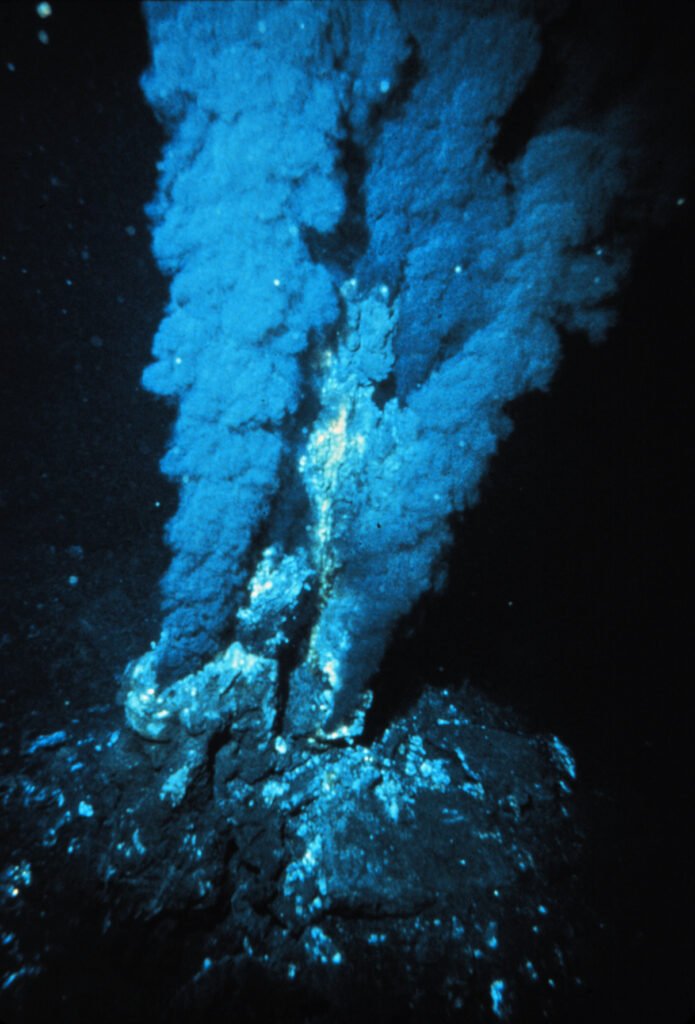
Two years later, in 1979, explorers on another mid-ocean ridge found "black smokers", tall mineral chimneys blasting out water at up to 400 degrees Celsius. The water stays liquid at that temperature only because of the crushing pressure at those depths. Its dark colour comes from metal sulfides that solidify the moment the hot fluid hits near-freezing seawater, building the chimneys up over time.
A Worm With No Mouth
The giant tube worm, Riftia pachyptila, became the symbol of the discovery, and it turned out to be even stranger than it looked. Adult worms have no mouth and no gut. They do not eat at all.
The explanation came from Colleen Cavanaugh, then a graduate student at Harvard, who proposed that the worms were fed by bacteria living inside their bodies. She was right. A spongy organ inside the worm, called the trophosome, is packed with chemosynthetic bacteria. The worm's red plume works like a gill, taking up oxygen, carbon dioxide and hydrogen sulfide from the water. A special form of haemoglobin, the same red molecule in our blood, carries the sulfide safely to the bacteria without poisoning the worm. The bacteria make the food, and the worm lives on what they produce. The work was published in Science in 1981.
Why It Matters Beyond the Ocean Floor
Since 1977, hundreds of vent fields have been found along the mid-ocean ridges, and scientists estimate around 800 animal species live at them, many found nowhere else. Vent communities can be wiped out by an eruption and recolonised within a few years by larvae drifting in from vents hundreds of kilometres away.
The discovery also changed the question of where life might exist. If whole ecosystems can run on chemical energy in total darkness, then sunlight is not a requirement for life. Some scientists now argue that life on Earth itself may have begun at hydrothermal vents. And when researchers think about the oceans thought to lie beneath the ice of Jupiter's moon Europa or Saturn's moon Enceladus, the vents on our own seafloor are the closest example they have of what life there might look like.
Sources and Credit
- "The Discovery of Hydrothermal Vents," Woods Hole Oceanographic Institution. whoi.edu
- "Benchmarks: February 17, 1977: Hydrothermal vents are discovered," Earth Magazine. earthmagazine.org
- "1977: Astounding Discoveries," Woods Hole Oceanographic Institution. whoi.edu
- Cavanaugh, C.M. et al. "Prokaryotic cells in the hydrothermal vent tube worm Riftia pachyptila Jones: possible chemoautotrophic symbionts." Science (1981). science.org
- Featured image: A black smoker hydrothermal vent releasing a dark plume on the Mid-Atlantic Ridge, by P. Rona, OAR/National Undersea Research Program (NURP), NOAA, via Wikimedia Commons, in the public domain. commons.wikimedia.org
- Image: A dense colony of giant tube worms with red plumes on the rocks of a hydrothermal vent at the Galapagos Rift, by the NOAA Okeanos Explorer Program, via Wikimedia Commons, in the public domain. commons.wikimedia.org
SAYKAYZ is a publishing platform, not a publisher of record. Any dispute over authorship or attribution is between the parties involved; please see our Terms of Service.