
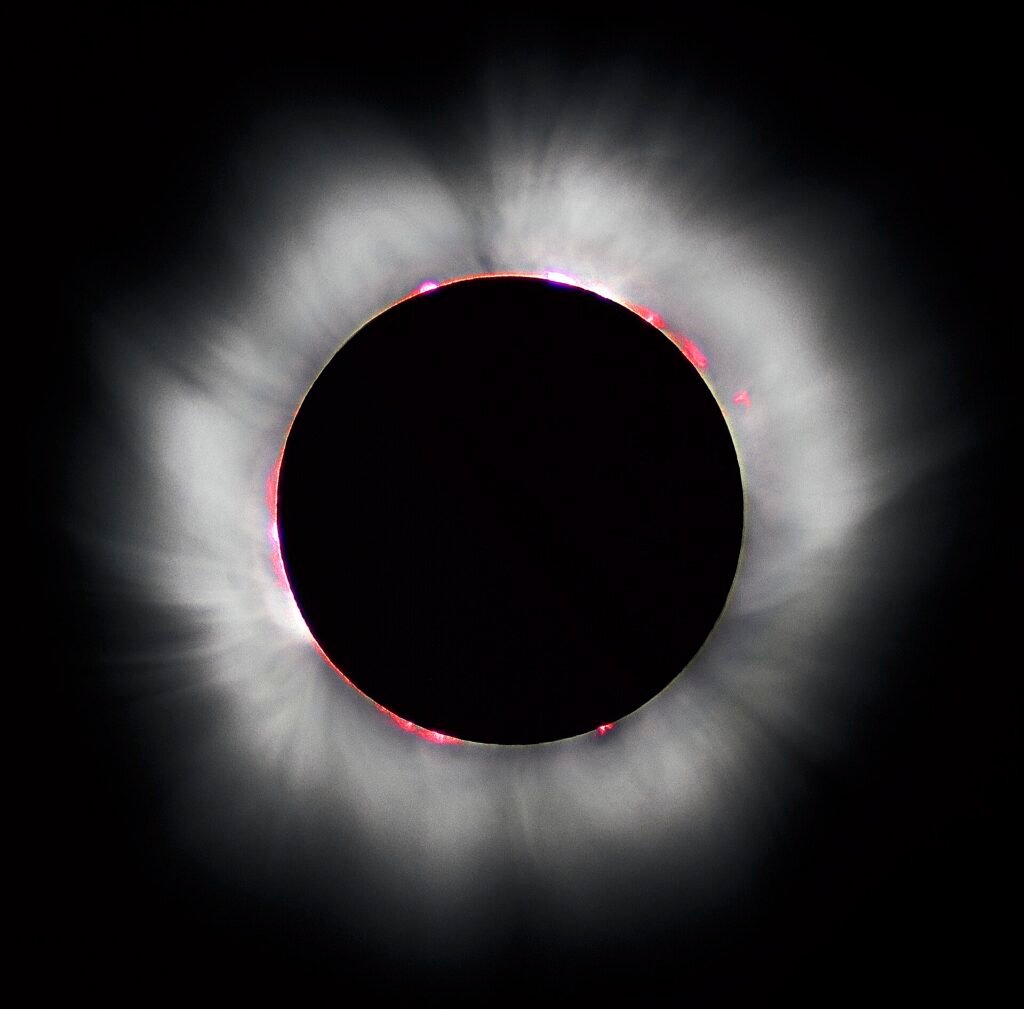
Stand next to a campfire and step back, and you get cooler. That is how heat is supposed to work. The further you are from the source, the colder it gets. The Sun breaks this rule in a way that has puzzled astronomers for more than eighty years.
The visible surface of the Sun, the photosphere, sits at about 5,500 degrees Celsius. Above it lies the corona, a thin outer atmosphere that stretches millions of kilometres into space. You would expect it to be cooler. Instead it reaches temperatures of a million degrees and more, in places around two million. Somewhere between the surface and the corona, the temperature jumps by a factor of hundreds. Working out why is known as the coronal heating problem.
A Mystery Element That Was Really Iron
The corona's strangeness showed up long before anyone knew its temperature. During eclipses in the 1800s, astronomers splitting its light into a spectrum found a bright green line that matched no known element. Some proposed a new one and called it coronium.
The real answer came in the early 1940s. Following work by Walter Grotrian, the Swedish physicist Bengt Edlén showed that the green line came from ordinary iron, but iron that had lost 13 of its 26 electrons. Stripping that many electrons from an atom takes enormous energy, and the only way it happens in a thin gas is at temperatures of around a million degrees. Many scientists did not believe it at first. Later measurements confirmed it. Coronium did not exist, and the corona really was astonishingly hot.
Two Main Suspects
Almost everyone agrees that the energy comes from the Sun's magnetic field. The surface is a churning mess of hot gas, and as that gas moves, it drags and twists the magnetic field lines rooted in it. The disagreement is over how that magnetic energy ends up as heat in the corona. There are two main ideas.
The first is waves. Shaking the base of a magnetic field line sends ripples up along it, much like flicking a long rope. These are called Alfvén waves, after the Swedish physicist Hannes Alfvén. If the waves carry energy upwards and then break up and dissipate in the corona, they could heat it.
The second is nanoflares. In 1988, the American physicist Eugene Parker suggested that as the surface motions braid and tangle magnetic field lines, the stress builds until the lines snap and reconnect, releasing a burst of energy. Big versions of this are solar flares. Parker proposed that countless tiny ones, each about a billionth the energy of a large flare, could be going off all the time across the corona, too small to see individually but adding up to enough heat.
Most researchers now think both processes probably play a part, with one or the other dominating in different regions.
Flying Into the Corona to Find Out
The best way to settle the question is to go there, and NASA has. The Parker Solar Probe, named after Eugene Parker, launched in 2018. In 2021 it became the first spacecraft to fly through the corona, crossing the boundary where the Sun's atmosphere gives way to the solar wind. On 24 December 2024 it made its closest pass yet, about 6.1 million kilometres from the Sun's surface, travelling at around 692,000 kilometres per hour, faster than any object people have ever built.
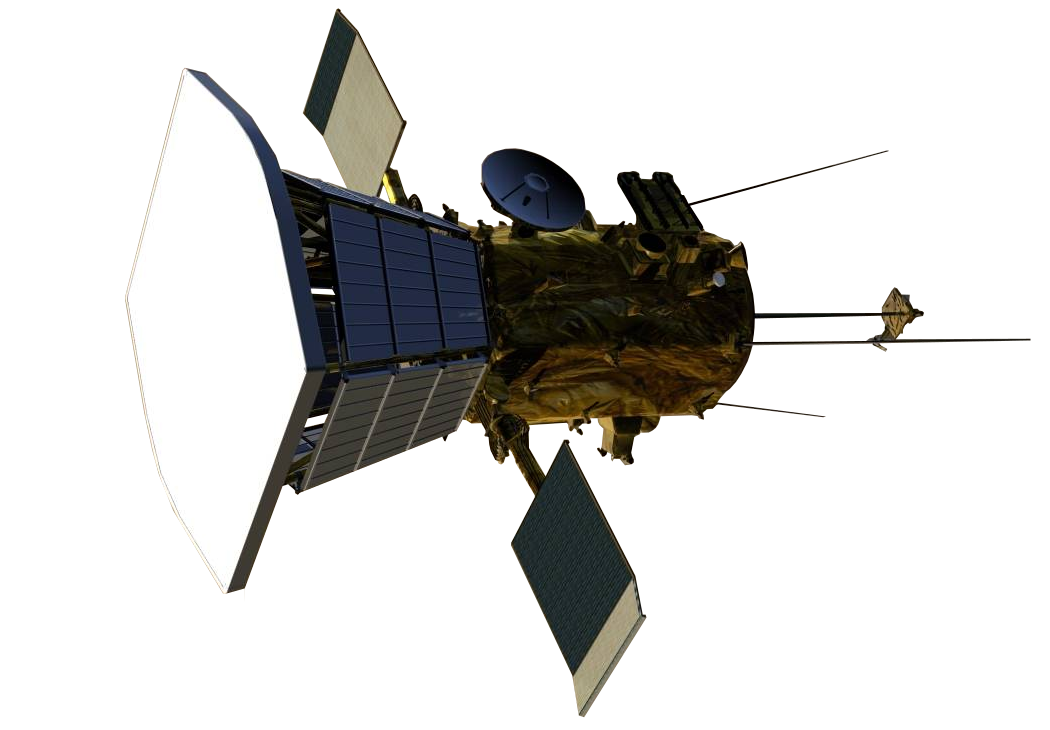
Among its early findings were "switchbacks", sudden S-shaped kinks in the magnetic field of the solar wind. The probe traced them back to the Sun's visible surface, to magnetic funnels rising between giant convection cells. How they form is still being worked out, but they may be tied to the processes that heat the corona. Each close pass adds more measurements of the waves, particles and fields in the region where the heating happens.
Still Unsolved, but Closer
The coronal heating problem is not fully solved, and it may turn out not to have a single answer. But the question has moved from "what could possibly explain this?" to "which of these processes does the most work, and where?" For a puzzle that started with a mystery green line during a nineteenth-century eclipse, that is real progress, and a spacecraft is still diving through the answer.
Sources and Credit
- "NASA's Parker Solar Probe and the Curious Case of the Hot Corona," NASA. nasa.gov
- "Sun: Facts," NASA Science. science.nasa.gov
- "Key events and characters in the problem of coronal heating," High Altitude Observatory, NCAR. people.hao.ucar.edu
- Parker, E.N. "Nanoflares and the solar X-ray corona." The Astrophysical Journal (1988). adsabs.harvard.edu
- "Closest approach to the Sun by a spacecraft," Guinness World Records. guinnessworldrecords.com
- "NASA Enters the Solar Atmosphere for the First Time, Bringing New Discoveries," NASA (2021). nasa.gov
- Featured image: The solar corona glowing around the Moon during the 1999 total solar eclipse, by Luc Viatour, via Wikimedia Commons, licensed CC BY-SA 3.0. commons.wikimedia.org
- Image: Model of the Parker Solar Probe spacecraft with its heat shield on top, by NASA, via Wikimedia Commons, in the public domain. commons.wikimedia.org
SAYKAYZ is a publishing platform, not a publisher of record. Any dispute over authorship or attribution is between the parties involved; please see our Terms of Service.