
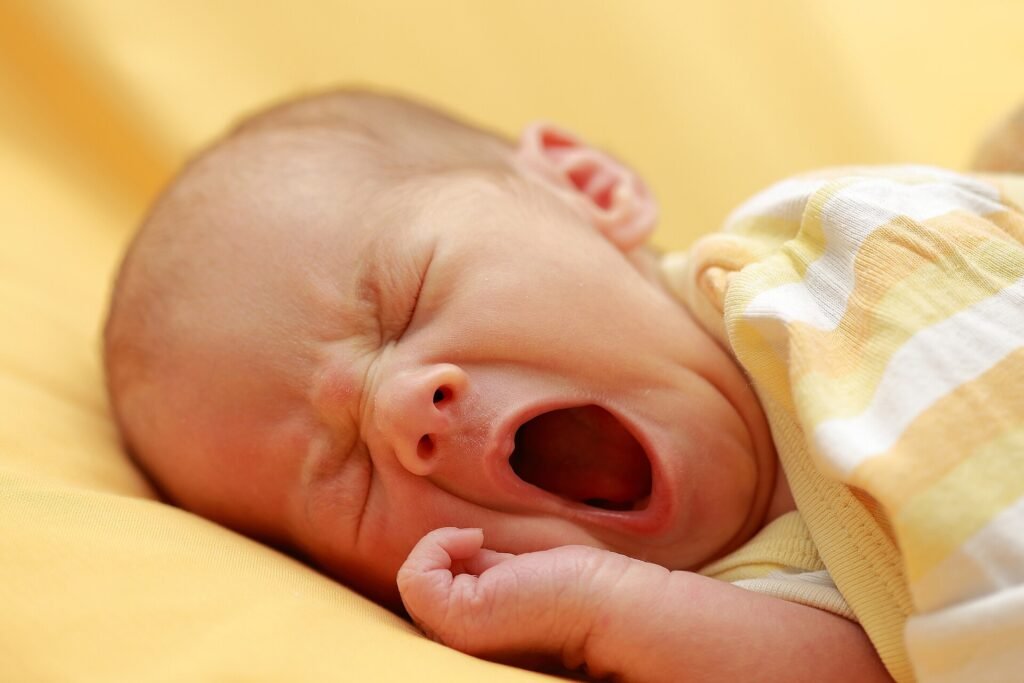
You have probably yawned at least once since you started reading this, or you will before the end. That is the strange thing about yawning: just thinking about it is often enough. For a reflex everyone has, it has been surprisingly hard to pin down why we do it at all, and why seeing someone else do it sets us off.
How Catching a Yawn Works
The contagious part is well documented. Psychologist Robert Provine spent much of the 1980s showing people videos of others yawning and counting what happened next. Roughly 55 percent of viewers yawned within five minutes. Later work found the effect does not even need a full face. Seeing a yawning face with the mouth hidden still worked, which suggests the brain is reading the whole expression, the squint, the stretch, the tilt of the head, rather than just the open jaw.

Humans are not the only ones who catch yawns. Chimpanzees, bonobos and dogs have all shown it in studies, though the results vary a lot between individuals and experiments. One popular explanation links it to empathy and social bonding, because people tend to catch yawns more readily from friends and family than from strangers. That idea is still debated, and it does not explain what the yawn itself is doing.
The Brain Cooling Idea
The most tested explanation for the yawn itself comes from Andrew Gallup, a psychologist who has spent years arguing that yawning helps regulate brain temperature. The reasoning goes like this. A deep yawn stretches the jaw hard, which increases blood flow to the skull, and pulls in a big breath of air that is usually cooler than the body. Together, that could flush slightly overheated blood away from the brain and bring cooler blood in.
It sounds like a just-so story until you look at the experiments. In a 2013 review of the evidence, Gallup and his colleague Omar Eldakar pointed to a study in rats where tiny probes measured temperature inside the brain. Yawns tended to follow quick rises in brain temperature of around a tenth of a degree, and were followed by a drop straight afterwards.
In people, the cooling idea makes a specific prediction. If yawning cools the brain, it should be most useful when the air is cooler than the body, and pointless when the air is as hot as the body. Researchers tested this on pedestrians in Tucson, Arizona. In summer, when the temperature hit about 37 degrees Celsius, roughly body temperature, people were much less likely to yawn when shown yawning images. In winter, at around 22 degrees, they yawned nearly twice as often. The researchers called this a "thermal window" for yawning.
Other experiments pushed on the same idea directly. People who held a cold pack against the neck, cooling the blood heading to the head, yawned less in response to yawning videos than people holding warm or room-temperature packs. People told to breathe only through the nose, which also cools incoming blood a little, yawned less too.
Bigger Brains, Longer Yawns
The strongest support came in 2016, when Gallup's team measured yawns from 109 animals across 19 species, from mice to elephants to humans. If yawning cools the brain, animals with bigger, more energy-hungry brains should need longer yawns. That is what they found. Mice averaged under a second. Humans averaged about six and a half seconds, the longest of the group. Yawn length tracked brain weight and the number of neurons in the cortex very closely, with correlations above 0.9.
So Why Is It Contagious?
If the cooling theory is right, contagious yawning might have less to do with sympathy and more to do with groups staying alert together. When one animal yawns, it may be resetting its own brain to a more alert state. If others follow, the whole group gets the same boost at the same moment. That fits with the fact that we yawn most when we are tired, bored or about to change activity, all moments when staying sharp matters.
None of this is settled. The cooling explanation has been criticised for relying on small temperature changes and on studies that are hard to run outside a lab. Yawning may do more than one job. But the next time you catch a yawn from someone across the room, your brain may be quietly turning down its own thermostat.
Sources and Credit
- Gallup, A.C. and Eldakar, O.T. "The thermoregulatory theory of yawning: what we know from over 5 years of research." Frontiers in Neuroscience (2013). pmc.ncbi.nlm.nih.gov
- "The Bigger Your Brain, the Longer Your Yawn," Scientific American, on Gallup et al. in Biology Letters (2016). scientificamerican.com
- "The Quest to Design the Perfect Yawn," NPR, on Robert Provine's research (2007). npr.org
- "Manipulating neck temperature can reduce contagious yawning in humans, study finds," PsyPost. psypost.org
- Featured image: A newborn baby yawning, by Martin Falbisoner, via Wikimedia Commons, licensed CC BY-SA 4.0. commons.wikimedia.org
- Image: Joseph Ducreux self-portrait showing the painter mid-yawn with arms stretched, by Joseph Ducreux, via Wikimedia Commons, in the public domain. commons.wikimedia.org
SAYKAYZ is a publishing platform, not a publisher of record. Any dispute over authorship or attribution is between the parties involved; please see our Terms of Service.